Ipinapakita ang mga post na may etiketa na at. Ipakita ang lahat ng mga post

Huwebes, Enero 5, 2017

Throwback Thursday 24 CP RS18 8773 at Hamilton ON in October 1978


CP RS18 #8773, still with it's 5" stripes on the cab face, pauses at Hamilton, ON in October 1978 with a rather unusual consist. Uncredited Kodachrome, author's collection.

Tonight’s Throwback Thursday takes us back to October 1978, at Hamilton, ON. We’re at the classic art-deco TH&B station, located near the downtown core on Hunter Street. Today it is a hub of GO Transit activity, but back on this day in 1978 it played host to a rather unusual train consisting of CP RS18 #8773, a CP steel caboose #434257, an Amtrak sleeper/combination car, and a TH&B heavyweight passenger car. What was this strange train doing at the station? Good question. There was no information on the slide mount, however the sequence of shots from this day shows the train at Toronto Union Station, here at Hamilton, and finally at the TH&B yard in Welland. At Welland, the engine and van were wyed and coupled to the back of an Amtrak train. While the reason for this odd operation may be lost to history, it may have been a director’s special of some sort. The Toronto-Hamilton-Welland routing is interesting, as it the mix of equipment – perhaps a joint effort by the TH&B’s parent companies, CP and Penn Central? Hopefully at least one other railfan was out that day and made notes on this train – this was of course, long before the days of email or facebook, where sharing of railfan information involved actually talking to someone else, in person or over the phone.

Interestingly, except perhaps for the station building, not much from this scene remains today. CP 8773, constructed in 1958 at MLW, was later rebuilt to RS-18u #1827 in 1985 at the company’s Angus shops in Montreal. The unit operated until 1992 when it was destroyed in a wreck at Mile 35.3 of CP’s Sherbrooke subdivision. Retirement followed in 1993, and finally scrapping at Winnipeg, MB in June 1994. Likewise, it’s probable that the CP van, Amtrak sleeper, and the TH&B heavyweight coach have all likely met the same fate. But at least we have this recollection of another one of those oddities that always seem to happen on cloudy days.

‘Til next time,
Cheers,

Peter.

Linggo, Disyembre 18, 2016

New Bachmann S 4 Arrives at Harlem Station


A new locomotive arrived at the PoNY Railroad's Erie Harlem Station with little fanfare but much appreciation today. With the 44 tonners down until a suitable decoder and sound system is found (I finally gave up on the LokSound I've been messing with for over a year now!), no. 514 (an Alco S-2) has been shouldering all of the duties by itself. The shiny new sound-equipped Alco S-4 no.529 is a welcomed site to the crews, and at under $100, the general accounting office couldn't complain.

I had already assumed I was going to have to change out the headlight since the double configuration seemed unusual, but again, another nice surprise that it is consistent with prototype. (Maybe all S-4s came this way?) Not sure how much closer I'm going to look, but I'm impressed with the out-of-the-box experience so far. Didn't even hesitate when I started him up. The crews should be happy.

Some prototype photos I've acquired lately of 529. Notice how close the first two photos were taken!

1970 at Jamestown, New York
A few milliseconds later in 1970 at Jamestown, New York
Post merger sometime/where

5 October 1971 at Croxton Yard, NJ


Delivered in October of 1952, no.529 was one of only 4 Alco S-4s (nos. 526-529) on the Erie who was a pretty good customer for Alco. I'm pretty sure they weren't bought because of the characteristic galopty-lop sound of the engines, but that is one reason why I like them.

Bonus material
An outtake from the 2 minute film session today. Even the simplest filming needs more than one take! The office crew got a laugh when no.529 moved in reverse instead of forward on the first take...


Miyerkules, Nobyembre 30, 2016

Throwback Thursday 17 CN CP9 4536 at Hamilton Jct


CN 4536 starts up the Cowpath with an eclectic 1980's consist. March 4, 1983, Keith MacCauley photo.


Today's Throwback Thursday features a guest contributor, my dad Keith. Here's his article on some CN GP9 action in the Steel City, back in the day (March 4, 1983). Thanks dad!
- Peter.

In this image we find back to back Canadian National Railways GP9’s Nos. 4536 and 4565 powering a relatively short mixed freight past the CN HAMILTON JCT. sign board as they head northwest (RR east) to merge onto the Dundas Subdivision and exit the ‘Steel City’. In the background above the tank cars is the York Boulevard structure known locally as the ‘High Level Bridge’. Note that 4536 is leading the consist long hood forward as Dick Dilworth intended when he created the legendary EMD GP diesel road switcher platform back in 1949. Perhaps not immediately obvious; the ‘Zebra Stripes’ on No. 4536 have been applied in reverse! (aside from CLC CFA/CPA/CPB’s GMD F/FP’s and MLW FA/FPA’s, the stripes should align on coupled units regardless of operating direction). Spotting features of the mid-production 1957 GMD-built GP9’s are twin 36” fans above each radiator section and a longitudinal fuel tank tucked under the frame between the trucks. Standard CN-issued accessories include the skate style cab roof antenna, below cab hanging re-railers, barrel-style spark arrestors, winterization hatch above the end radiator section, forward mounted bell, MU connections and cross over platforms. Note that 4536’s foot boards are still in place! Trailing the 16-567 powered duo is one of CN’s then-numerous boxcar come caboose (aka ‘van’) created at the mammoth Montreal based Pointe St. Charles facility. Attached to the PSC van are a couple of CN’s modernized 40 ft. boxcars (shortened ladders – no roof walks) and a hodge-podge variety of freight cars. Vans at both ends of the consist most likely imply that the crew has a long afternoon of switching ahead of them in Brantford involving a number of reverse moves requiring crew protection.

Remarkably, the overall scene above is little changed today, although work is currently ongoing that will significantly alter the landscape – a project was recently launched to widen the grade such that a third mainline track can be added adjacent to the bay side right of way. Noteworthy ‘can you spot the differences’ include removal of the maintenance shed (above the first 40 ft. boxcar) and track immediately parallel to 4536 (which actually stub ended a couple hundred yards past the signal). As well, unseen in the distance is enhanced track work under the High Level Bridge added several years ago to bring GO Train service to the former T, H & B Hunter Street station. No doubt the signals shown have been revised and updated.

What has become of the GP9 duo? Incredibly, both are still extant. No. 4536 was remanufactured in 1992 into GP9Rm #7053 by Pt. Ste. Charles and continued to serve her original owner until late 2010. Declared surplus, the unit was sold off and is now part of the Rail Trust Equipment Fleet as RTEX 7053. Wearing her fifth (at least) paint scheme, she is currently dressed in an attractive black with diagonal orange end stripes design (http://www.rrpicturearchives.net/showPicture.aspx?id=3401167). Similarly, 4565 was remanufactured by PSC into GPRM #7231 in 1986 and continues to serve her original owner on Canada’s west coast out of Prince George in central British Columbia. (http://www.rrpicturearchives.net/showPicture.aspx?id=1595368)


Otherwise, the PSC van and 40 ft. boxcars are of course long gone, as would be any unrebuilt freight car from the consist manufactured prior to July 1, 1974 (freight cars built prior to July 1, 1974 are limited to an AAR Interchange life of 40 years, those built after; 50 years). Most likely the steel is still with us, albeit recycled into another form - I wonder if Gillette bought any of the steel from these cars?!

- Keith.

Lunes, Oktubre 17, 2016

FPA 4 Friday VIA 6793 at Toronto ON in August 1986


VIA Rail FPA-4 #6793 trails on an equipment move from Toronto Union Station to the VIA servicing facility at Mimico on August 4, 1986. Uncredited slide from my collection, but I believe photographer is either Reg Button or Bill McArthur.


A busy day for me yesterday didn’t leave any time for a Throwback Thursday, but to make up for it, here instead is FPA-4 Friday - a look back to the summer of 1986. It’s August 4th of that year and we are at Bathurst street in Toronto, Ontario, on a bright and sunny morning. Through the viewfinder we observe this rather odd, “everything but the kitchen sink” consist that includes VIA FPA-4 #6793, three RDC’s, and FP9 and even an Ontario Northland coach. The oddball collection of equipment is in fact an equipment move from Toronto Union Station to VIA’s Mimico servicing facility, located a few miles down CN’s Oakville subdivision, west of Toronto. It appears that three separate trains have been combined to ferry the consists to Mimico for servicing before heading out on other trains later in the day. We can guess that the FP9 and three cars on the west end of the move are from a westbound train, perhaps from up north judging by the ONT coach in the consist (perhaps VIA equipment had been used on that day’s Northlander?). The RDC’s are likely off of an eastbound train in from Niagara Falls, as they were common on VIA trains in the area until LRC/HEP-II cars took over and the RDC’s were retired. And the 6793 and two east-end cars are also likely off of an eastbound, perhaps the morning Sarnia train (#84) that came down the Guelph sub by way of Stratford, Kitchener, and Guelph. Any way you slice and dice it, there’s a lot to look at in this photo!

What has happened in the intervening 29 years? A lot, as it turns out. The most obvious change in the photo is the equipment – the “Blueline” coaches, the FPA-4, the FP9, and almost certainly the RDC’s were phased out and replaced by VIA’s current roster of GE P42DC’s, GMD F40PH-2’s, LRC coaches, and Budd-built HEP-II cars. A handful of RDC’s are retained for the Sudbury-White River operation, in a modified paint scheme with silver ends instead of yellow. Another major change is that the tracks in the background diverging to the right, the CN Weston subdivision has been greatly modified to incorporate a major grade-separation project, and the tracks have been lowered significantly in this area. The area in general now is considered the Union Station Rail Corridor, and operated by provincial transit authority Metrolinx (operator of GO Transit as well). In fact, Metrolinx now owns the Oakville subdivision all the way from Union Station to Burlington West, about 32 miles (though CN still serves local customers on the line, primarily at night). Some tracks at left have been removed (as has the freight yard in the distance at right), and the building in the centre has been demolished; high-priced glass-exterior condos now dominate the area. One thing that hasn’t changed? – the signal bridges. All three signal bridges that the train is passing under still stand, though plans to replace them with the modern aluminum structure, LED-lit “Darth Vader” signal bridges probably aren’t far off.

What about VIA 6793? – well, the engine not only dodged the scrapper’s torch, but evidently earned a vacation, now enjoying the Arizona sunshine as Grand Canyon Railway 6793. Painted in a bright silver and gold paint scheme, the engine now hauls trainloads of tourists in and around Williams, AZ. I bet it doesn’t miss the cold Canadian winters! A number of ex-VIA FPA-4’s survive in the US, on shortlines/tourist operations such as Grand Canyon Railway, Napa Valley Wine Train, New York & Lake Erie and Cuyahoga Valley to name a few.

‘Til next time,
Cheers,

Peter.

Miyerkules, Agosto 24, 2016

Throwback Thursday 14 TH B GP7 77 at Guelph Junction July 18 1984


The CP/TH&B Goderich Turn pauses while switching with TH&B 77 &401 at Guelph Juntion, near Campbellville, ON, on July 18, 1984. Reg Button photo, author's collection.
Today’s Throwback Thursday takes us back to July 18, 1984; it’s late in the day at Guelph Junction, located 39.2 miles up the Galt Sub from Toronto. Guelph Junction is an interesting place on the Galt Sub, and is the location where the Hamilton Sub joins the Galt Sub (from the south) and where the Goderich sub branches off northward to Guelph (cut back from Goderich in the late 1980’s). What remains of the Goderich Sub is owned by the city of Guelph (the only municipally-owned common carrier railway line in Canada) and now operated by shortline Ontario Southland Railway. Interestingly, the two branches are not directly connected to each other, but a pair of wyes (facing north and south) are used to bring trains on or off the Hamilton/Goderich subdivisions. Guelph Junction also marks the end of CTC territory originating in Toronto, and where OCS track warrant territory continues another 74 miles to London (except for CTC islands at Wolverton and London). A GO transit storage facility was located here for a number of years, used to store GO commuter trainsets used on the Milton line in the evenings or on weekends. Discontinued a few years ago when a new layover facility was constructed in Milton, use of the yard is now confined to OSR/CP interchange to the shortline. At one time, the Goderich sub featured a daily-except-Sunday passenger train from Hamilton to Goderich, usually powered by one of the road’s quaint 4-4-4 Jubilee engines, and included an unusual reverse move at the junction to cross the Galt sub (northward train would pull around south wye, back down the Galt sub, and carry on northward around the north wye and onto Goderich). If a Jubilee wasn’t available, or if the regular engine broke down, a spare engine stationed at the junction would be used to power the local passenger train. Often this was a P-1 or P-2 Mikado, which made for quite the interesting little passenger train! Additional passenger service was provided by a CP gas-electric doodlebug based out of Guelph, and often made several round trips between Guelph and the junction (about 15 miles) per day.

Through the viewfinder, we observe a pair of TH&B geeps, GP7 #77 and GP9 #401. The subject train (though apparently absent of cars this day) is the Goderich Turn, operated north out of TH&B’s Aberdeen yard to its’ namesake port on Lake Huron. An interesting operation, the train commonly operated with TH&B-supplied power, often with just a single unit. This is especially interesting considering the steep descent down the Niagara Escarpment from Guelp Junction and the TH&B units’ lack of dynamic brakes. The pair of units on today’s train is an interesting anomaly, considering TH&B’s common practice of using borrowed engines to power its’ own trains. It appears that the train is making a switching move at the time of this photo – note the conductor with his large shoulder-slung radio appears to have just lined the main line switch back to the normal position. Most of what is visible in this photo is now gone – the CP Chevy van undoubtedly disposed of after years of service, and the station demolished to make way for additional GO Transit storage tracks, the TH&B geeps, and even the train order semaphore, a Guelph Junction landmark for decades. But for at least a moment back in July 1984 we can imagine what the geeps’ 567 engines sounded like while switching at the Junction.

‘Til next time,

Cheers,
Peter.

Miyerkules, Hunyo 29, 2016

HBS 701 at Bethlehem Shipyard 27 August 1960


Biyernes, Hunyo 24, 2016

Chapter Ho train sets at walmart


Ho train sets at walmart

Take a look Image Ho train sets at walmart  Trains McKinley Explorer HO Scale Ready to Run Electric Train Set

Ho train sets at walmart

Buy trains & train sets online walmart canada, Thomas and friends trackmaster switches and turnouts track pack let you connect additional track pieces to your toy train sets and expansion packs, or you can use. Ho scale modeltrainstuff.com, Welcome to the ho scale train department! new product releases and re-releases will be listed on this page as they arrive.. Walmart.com: save money. live better., Online shopping for the largest selection of electronics, home furnishings, video games, baby gear and more. shop online and save money to live better, at walmart.com..
Dreamworks dragons - wikipedia, Dreamworks dragons is an american computer-animated television series based on the 2010 film how to train your dragon. the series serves as a bridge between the first.
# milwaukee 12 volt battery charger - battery life, ★ milwaukee 12 volt battery charger - battery life maximizer reconditioned cordless drills for sale battery charger 36v 18 cell.
Two year free replacement guarantee - model train diorama, Yes, military orders are welcome. shipping times for military orders cannot be predicted. all military orders are shipped using the united states postal service and.

Linggo, Mayo 15, 2016

Throwback Thursday 9 Passenger Action at Bayview in February 1977


Competitors meet at Bayview on a cold Winter's day in February 1977. Uncredited Kodachrome, author's collection.

Today’s Throwback Thursday takes us back to the winter of 1977, on a cold but sunny day in February of that year. Here we find an interesting scene with a combination of passenger trains from both CN and CP. Westbound CP #181 is heading through the plant (away from photographer, note rear marker lights illuminated) while an eastbound CN Tempo consist holds on the Dundas sub until the CP train clears. We can probably assume that the CP train was delayed for some reason, after all this is CN’s track and they probably wouldn’t intentionally delay one of their own trains to allow a competitor to have priority. Whatever the reason, the result is nonetheless worthy of further consideration.

The equipment on the two trains presents an interesting contrast in Canadian passenger operations – one attempting to economize and shrink passenger train size, and another an attempt to modernize and improve the passenger experience. When the photo was taken, VIA had been formally in existence for about a month, but it would be more than a year (October 29, 1978) that it would officially take over CN and CP passenger operations. Thus, the two trains are still operated at this date by their respective owners and not yet by the crown corporation.

The CP train is the last vestige of the old Toronto-Buffalo connection by way of Hamilton/Fort Erie (over CP/TH&B), a service initiated in 1894 and terminated when the last #181 to Buffalo was run on April 25, 1981. Gone are the days of the torpedo-tube TH&B GP9’s hauling steam-heated passenger cars (with overnight Toronto sleeper connections), and by this date, the train has been reduced to a two-car RDC consist; at least it is sporting the attractive ‘hockey mask’ paint scheme. The trailing RDC (or “Dayliner” to Canadians) is somewhat of an odd duck, being an RDC-4, a baggage-only model with no passenger seating (73’ long, 12’ shorter than other RDC models). The fact that the train only has one car for actually seating passengers probably speaks to its' popularity by this date. The unit was built by Budd in 1955, and subsequently sold to VIA in September 1978. Evidently not fitting into VIA’s operational plans, the unit was sent to CN’s Pointe Ste. Charles shops in Montreal and subsequently stripped of useful parts to keep other RDC’s going. The remains were scrapped at Dominion Metals & Refining Works at St. Constant, Quebec in 1985.

Though we can’t make out the number of the CN Tempo RS18, it was nonetheless representative of a concerted effort to modernize and improve CN’s passenger operations along the Toronto-Windsor corridor. Rebuilt from a standard RS18 in 1967 with a new-for-the-time HEP system, the six converted RS18’s powered Tempo operated with cars from a group of 25 purpose-built aluminum coaches built by Hawker-Siddely in Thunder Bay, ON. CN 3150-3155 (MRE-18g) featured 92 MPH gearing, a unique paint scheme, and a 575-volt HEP system. The coaches featured outboard disk brakes, electric doors, microwaves, and improved snack service. Delivery of the LRC equipment in the mid-1980’s ultimately rendered the Tempo trains obsolete, with the locomotives and cars being retired by 1983/1986 respectively; their unorthodox 575-volt HEP system didn’t jive with the new Amtrak/VIA standard of 480 volts, greatly limiting the equipments’ usefulness in combination with other car types. Interestingly though, like a cat with nine lives, several of the coaches were subsequently resold to the Rio Grande for use on their Colorado Ski Train operation; the cars were then re-sold some of the cars to the CN/ACR Agawa Canyon tourist train operation, returning the cars to Ontario, albeit much farther north than they were initially accustomed to! Approaching their 47th birthday, it is indeed remarkable that these cars – especially given their aluminum construction – are still polishing the rails!

‘Til next time,

Cheers,

Peter.

Miyerkules, Abril 20, 2016

Throwback Thursday 10 – GT 4612 at Palmer MA In January 1992


A snowless January 24, 1992 finds GT 4926 on the point of a switching move while interchanging cars with CSX. David Simmons photo, author's collection.

OK so a little late, but it’s still Thursday (on the west coast) – today’s Throwback Thursday takes us back to January 24, 1992. We’re at Palmer, Massachusetts, the location of the crossing between CSX’s former Boston & Maine Selkirk-Boston mainline and the Grand Trunk (Central Vermont) line from St. Albans Vermont to New London Connecticut. In this photo by David Simmons, taken on January 24, 1992, the CN-controlled GT is making a reverse move to the interchange yard located adjacent to the CSX tracks toward the east side of town. The GT’s own yard is located to the west, on its’ own north-south line. The power for this move is GT 4612-CV 4926-GT 4605.

In the intervening 23 years, a good deal has changed at Palmer. The most obvious change was the takeover of the CV by Railtex’s New England Central Railroad in 1995. Gone were the blue and red (or green and yellow) geeps, replaced by GP38’s in an attractive yellow and blue paint scheme. Railtex was folded into RailAmerica in 2000, itself taken over by Genesee & Wyoming a few years back. Another shortline, Massachusetts Central also interchanges with CSX at Palmer, utilizing trackage rights over NECR south from their own line north of town. Power for the Mass Central is (among others) a pair of leased GP38-2’s in a retro-B&M paint scheme, a GP9 in the same paint scheme, and an eclectic ex-Southern NW5. Not only have the railroads changed, but the former GT station is now a popular local eatery, the Steaming Tender Restaurant; I’d be hard-pressed to find a better railfan-friendly restaurant!

What about the locomotives? GT 4612, a 1989 graduate of the GT GP9 rebuild program at the railroad’s Battle Creek Michigan shops, was no stranger to the area, having been built at CV GP9 #4923 in March 1957. The Battle Creek shop forces overhauled the mechanical systems on the engine, but more noticeably chopped the nose and applied an EMD Spartan-type cab; additionally, the unit lost its’ distinctive “torpedo tube” rooftop air tanks. Following its’ rebuild, the engine served the CN North America system until 2011 when it was sold to the Carolina Coastal Railway, and became CLNA 4612. Photos on the internet reveal that the engine is alive and well on the CLNA in and around Wilson, NC, still largely in its’ early-90’s blue and red paint. CV 4926 was likewise built in March 1957 and also eventually got chop-nosed (retaining existing cab and getting new number boards), but interestingly retained its’ green and yellow paint scheme. Evidently not as popular as the GT rebuilds, the unit was sold to the Arkansas & Eastern Railroad in 1993. GT 4605 began life as CV 4551 and similarly went through the GT rebuild program in 1989. The unit survives today as SSRX 4605 (Manning Rail), a grain elevator switcher at Fairmont, NE – a long way from its’ New England background! The unit is painted in a nice red and blue paint scheme.

A couple of my photos from a day spent railfanning the junction on July 8, 2014:

NECR 3015, the former CN 9457 is probably not a stranger to the rails through Palmer. Here is is seen shoving a good-sized cut of cars to the CSX interchange on July 8, 2014. Photo by author.
Mass Central 1751, in a nice modern rendition of the classic B&M paint scheme, has set off the interchange cars for CSX and heads back to home rails with a handful of cars for the shortline's customers. Author's photo, July 8, 2014.

Steaming Tender Website

‘Til next time,
Cheers,
Peter.


Linggo, Nobyembre 22, 2015

Orange continues at a good pace


I've used this holiday weekend to get as much as I can done on the lower level at Orange.  It a weird setup, like a "L" shadow box, so I have to make sure I get everything done before I cannot reach certain areas.  This includes soldering feeder wires, painting the background blue and other small tasks.  The Norfolk Southern interchange can hold 4-5 cars and the VMID interchange can hold 3 cars.  These car lengths are 50' based.
Here is the entrance to Orange.  The spur to the left goes to the NS interchange and a untreated tie loading facility.  The trackless turnout will lead to the edge of the layout and a cassette for the VMID interchange.  The toggles on the right are for the signals at City Junction above.  

The interchange track is the closest and the tie place has the gondola on it's track. 

The track the gon is on is not glued down in case I need to move it.  

Here is the hidden trackage that leads to Orange.  Had to make sure that trackage was good to go before proceeding.  

The good thing about working on this lower level is that I've done it in a chair.  By the way, operating the lower level is strictly done in the chair! 

The interchanges will be an easy reach  for operators.  This view is right by the door.  

Did I mention my office is a total wreck!  This items in the middle of the room were under the area I'm working in.

Future expansion?  Might extend this area towards the me about 2-3 feet and take out the creek and bridge scene.  This would make the aggregate area a lot bigger.  But would require another crossing of the Midland.  Stay tuned.

Martes, Setyembre 8, 2015

Photo of No 19 at New Harlem Freight Station


I recently found a copy of Erie Railfan (vol 1, no. 3, pp 8-9, Summer 1973) that has the second part of an excellent Larry DeYoung article on first generation diesels. Included is this photo (Ed Kelsey) of no.19 at the Harlem Station (149th Street). The building behind it is the office and freight house located on the Exterior Street side of the yard looking E-SE. No.19 was actually the fourth boxcab Erie acquired in 1928 (no.20 was the first in 1926 and nos. 21-22 in 1927).

The photo and article provide some interesting and relevant data for my layout. I now know that no.19 was at Harlem on June 12th, 1949, and that it had its end tiger striping. Cross referencing another photo from the Railroads of New York Harbor 2010 Calendar by George J. Abere, Jr. in April of 1955 shows that the striping is still there, and since it is a color photo, I know the striping is yellow as is the lettering and herald on the sides.

I also have a good reference for the building windows, awning and configuration in '49. I haven't researched this fully, yet, but the building changed over the years, so this adds a piece for nailing down what it looked like if I want to choose a specific year to model it (or perhaps multiple models for different years?)

1954

Also of note is that it looks like the ground is paved with concrete, which is previously unknown information to me. So, I go to historicaerials.com and search for "Exterior St and 149th, New York", and I find aerials from 1954 (above) showing the concrete paving. The tracks are also uncovered at this point, and I know from a 1957 photo that the two tracks, along with others) are enclosed by a building. There is also a neat feature that allows you to compare photos side by side with a slider to reveal one or the other photo. I choose 1966 and 1954 to compare (the oldest available), and notice not only the new building, but also maybe some new tracks by the centrally located crane and an elevated I-87 over Exterior St. (below)
1966

So a really good find leads me through a slew of resources to have a better idea of the evolution of the yard. I think I prefer the smaller building without the covered tracks, which means pre-'57 at some point. I may go to 1959 and simply construct the walls of the building with a removable roof for operation, or, better yet, just say it is '59 and not have the building. (Don't tell anyone if I end up doing that.)


Huwebes, Agosto 20, 2015

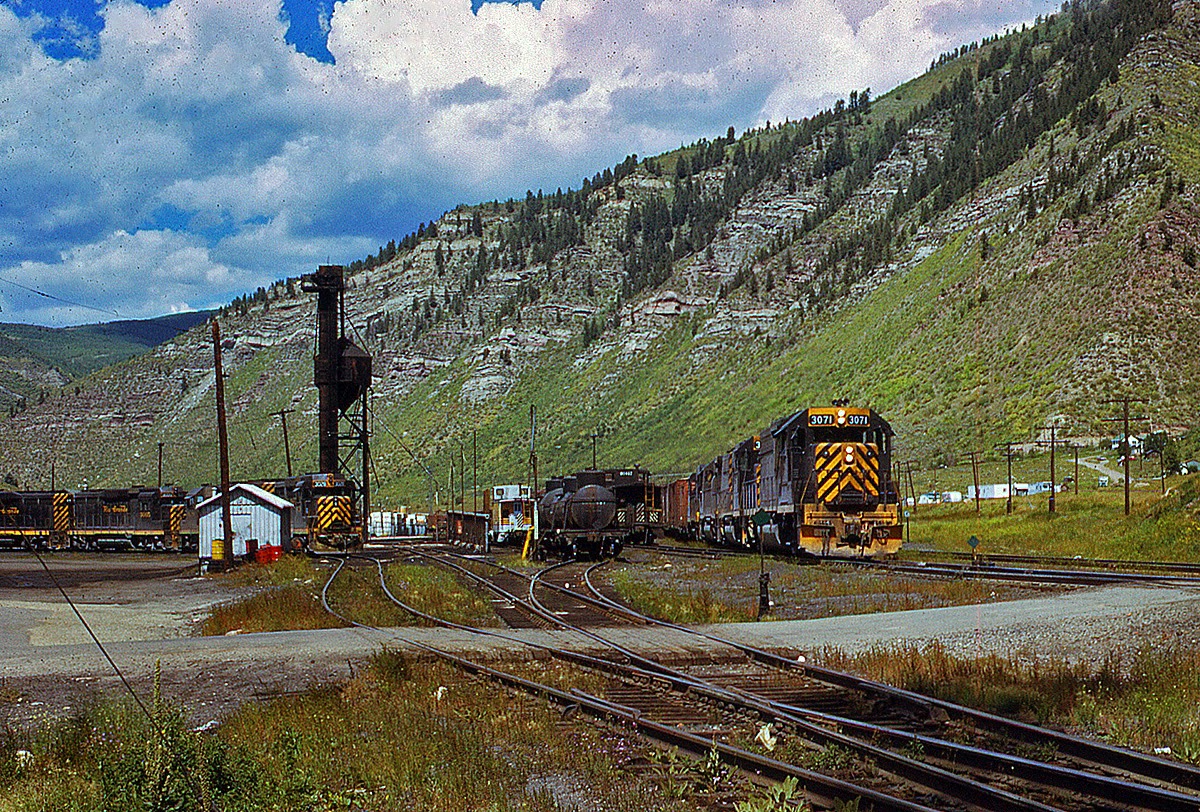
Throwback Thursday 2 DRGW 3071 at Minturn CO July 1968


DRGW GP40 #3071 pauses at Minturn, CO in July 1968. John W. Maxwell photo, author's collection.

One hobby of mine is collecting and trading 35mm photographic slides of trains and railroad equipment. Last year, I acquired a small part of the photographic collection of John W. Maxwell, a photographer well-known among the narrow gauge community in the western United States. From the information I could gather, John was a mechanical engineer who was employed by Union Pacific in Colorado. I believe he lived in Denver, although that is only a guess based upon where the bulk of the photos were taken. John was popular among narrow gauge enthusiasts for his extensive photography of narrow gauge equipment and for making highly accurate scale drawings of narrow gauge rolling stock and equipment. John took photos for over 60 years, and from what I can find on the internet, the location of the bulk of his photographic and drawings collection remains a mystery. But instead of dwelling on where the collection went, let’s enjoy the view he captured in the photo above.

We’re at Minturn, Colorado in July 1968 – the sanding tower in the photo easily recognizable to any fan of The Mainline Through the Rockies. In this view we find one-and-a-half year old GP40 #3071 leading an eastbound that has stopped at the yard.  Minturn is located on the west side of the infamous Tennessee Pass, and is a town long associated – and closely tied to – the railroad. It was here that nearly all eastbound trains stopped and had helpers added to the train in order to overcome the 3% grades further up the pass. Though the train is eastbound, the tracks here run almost north-south allowing for good lighting of eastbounds almost all day long; it appears to be perhaps late morning at this click of the shutter. By this point in time, the 26 SD45’s are all on the property, but the railroad is still largely dominated by turbocharged four-axle locomotives, as evidenced by the consist of this train as well as the power in the distance. It would be another six years before the tunnel motors synonymous with the DRGW in its’ later years would show up, and we’re still not quite into EMD’s Dash-2 era yet
. We can safely surmise that the three GP30’s and a unit hidden by the shed are a helper set that perhaps will cut in partway back in this train, or another eastbound later in the day. Between the two lashups are no less than four (!) GP30’s along with an equal number of GP40’s or GP35’s. What a sound it must have been to hear this train leave town!

The lead unit, DRGW 3071 would go onto have a long and interesting history (most information from Don Strack’s Utah Rails site). It was the third of twelve GP40’s delivered to the Rio Grande in early 1967, and one of many high-horsepower four axle units that the railroad owned. The unit was converted into a trailing-only unit (“B-unit”) in 1972 with the removal of the radio, cab seats and other lead-required equipment; 24 other GP40’s and a number of GP30’s and GP35’s were similarly modified in an effort to reduce operating costs. The engine remained in this condition for many years and into the Southern Pacific era, when it was returned to a lead-capable unit. Eight years after the Rio Grande – Southern Pacific merger in 1988, the engine became part of the massive Union Pacific system in 1996. Under UP ownership, the engine left home rails and travelled far from its’ Tennessee Pass rails in the photo above. Photos on the internet reveal it travelled at least as far as Houston, TX and North Little Rock, AR. Ownership by UP lasted only five years, and in May 2001 the engine was retired after 34 years of service. A sale the next year to National Railway Equipment the following year took the engine to Silvis, IL, where the unit became a donor for one of the NRE’s many rebuild programs. Eventually, this unit was rebuilt by NRE, emerging as BNSF 2013 in late 2006 or early 2007. No longer a GP40, the locomotive is now mechanically a GP38-2, including a 16-645E non-turbocharged prime mover, oil-bath air filter box, new electrical gear, and just two radiator fans (the middle one was removed in the rebuild). A testament to EMD design, the engine should be around for many more years to come, having outlived its’ original owner and even Tennessee Pass itself.

 I am grateful to John Maxwell for taking the time and effort to record this scene on film – in future posts I will share more of the slides acquired from his collection.

‘Til next time,

Cheers,

Peter.

Huwebes, Agosto 13, 2015

Throwback Thursday 7 CNR 6218 at Hamilton ON Ferguson Ave in January 1966


CNR 6218 leads a railfan excursion southbound through downtown Hamilton, ON on a snowy day back in January 1966, with a good-sized crowd in attendance. Uncredited slide, author's collection.
Since we’re still in the grip of winter here in southern Ontario, today’s Throwback Thursday takes us back to another snowy day in January 1966. In the above photo we see CNR 4-8-4 #6218 southbound on a railfan excursion over the CN’s Hagersville sub, on the infamous portion of street running through downtown Hamilton, ON.

Running from a connection to the CN Grimsby sub near Elgin street in north Hamilton, the line extended southward through the city and up the escarpment (“the mountain” to Hamiltonians), and from there through its’ namesake town to Jarvis, where it met the “Canada Air Line” (CN Cayuga sub). Aside from running north-south in an otherwise east-west dominated area of trackage, the line was also noteworthy for its’ street running portion, the steep grade up the mountain, and in later years, it gained additional fame when the Hamilton-Nanticoke steel train ran over the line with an A-B-A set of F7’s.

Long before the F’s became a fixture on the line, however, CN was known to run railfan excursions over the line with their popular Northern engines 6218 and, at least on one occasion, CNR 6167. Not generally a through line, there was little traffic to interfere with the railfan excursions; moreover, it provided a convenient way to turn a train without wyeing it (i.e. Windsor-Caledonia, Caledonia-Hamilton, Hamilton-Windsor; this particular arrangement likely never actually took place but is used to demonstrate logic of turning the train without a reversing move). Interestingly, the big CNR Northerns were not native to the line in the days of steam – quite the opposite in fact. Due to weight restrictions over the antiquated Grand River bridge at Caledonia, the line was restricted to the use of lighter engines, particularly CNR’s E-10 moguls. The light engines were insufficient for the steep climb up the mountain however, thus doubleheading (or even tripleheading) was common, with the helper(s) cutting off at Rymal, Glanford, or sometimes Caledonia if tonnage was heavy enough. A new bridge installed in 1953 eliminated the weight restrictions, and allowed heavier power such as the J-4 Pacifics, N-5 Consolidations, or H-6 Ten-wheelers, though the E-10’s were still common on the line. Undoubtedly the largest steam ever operated on the Hagersville sub, the CN Northerns on occasion did require helpers if traversing the line southward (up the grade), particularly in winter.

Which makes this photo that much more interesting. Indeed, the train is southbound on the Hagersville sub, heading for the climb up the mountain. Since helpers on the excursions were usually placed in front of the steam locomotive to simplify their removal at the top of the grade, it would appear that this excursion will climb the grade without helpers (the steam obscures the view of part of the train behind the engine, but it does not appear that helpers were added on this trip). This is even more interesting considering that the city appeared to have got a pretty decent snowstorm shortly before this excursion – note that Ferguson Avenue isn’t plowed! It would appear that the train is perhaps 8-9 cars long, likely well within the capability of the big Northern to pull up the grade – though I wonder if there was ever a calculation done to see what the tonnage rating would be for a U-2 Northern southbound up the grade?  The train is about to make the sharp left turn, cross the TH&B tracks and begin the climb up the grade to Rymal - I bet the sound would have been fantastic!

Being that the photo was taken in downtown Hamilton, we are fortunate to have an exact location for the photo, even though there was no information on the slide mount. The street sign in the photo reveals that the photographer was standing at the corner of Ferguson Ave and Hunter Street. Another slide I have shows that he took a photo of the street sign up close, perhaps to remind himself where he was on this particular day. It also appears that the photographer was in good company this day – note how many other people are out on a snowy day to observe this special run. I doubt that if CN still ran excursions today, that many people would stop to watch – or even care about – the magnificent Northern leading a passenger train. The crowd in the photo is probably heavily biased towards railfans I would guess. A Google Streetview image of the same location today reveals that the area has been entirely reconfigured. What was once a mostly-residential neighbourhood has been somewhat commercialized, and many of the houses have been demolished and replaced with apartment buildings. One would be hard-pressed to even recognize that a rail line ever ran down the street! (Which interestingly, has been paved with bricks, as if to make it easy to replace the line if CN ever chose to do so – but will never happen). Though I bet if they did, the view from some of those apartment buildings would be awesome...

A snapshot from Google Streetview of approximately the same angle as the above photo, taken almost fifty years later. Photo credit: Google.

But at least the subject photo reminds us that not all grey winter days are dull – often the best action seems to happen on grey gloomy days!

‘Til next time,
Cheers,

Peter.

Martes, Hunyo 23, 2015

Throwback Thursday 8 Amtrak E8A 284 at St Thomas ON in August 1975


Amtrak E8A #284 pauses at St. Thomas, Ontario with eastbound train #64, the Empire State Express. Three locomotives for five cars seems a bit excessive! Date is approximately August 20, 1975. Uncredited Ektachrome, author's collection. 

Our Throwback Thursday today takes us back to August 1975 on a sunny morning at St. Thomas, Ontario. Amtrak E8A #284 is piloting train #64, the eastbound Empire State Express, and has stopped in front of the massive Michigan Central (or CASO to die-hard fans) station to entrain passengers heading to the Big Apple. Today’s train is unusual for a couple of reasons: first, the second E8A (the train typically ran with only one locomotive), but far more interestingly, the Delaware & Hudson PA1 sandwiched between the two Amtrak engines. What was the classy ALCo doing in southern Ontario? Delaware & Hudson, long a proponent of Schenectady-built locomotives, had contracted with Boise, Idaho-located Morrison-Knudsen to rebuild a number of 244-powered locomotives with 251 engines. Included in the program were the four ex-Santa Fe “blue-bonnet” painted PA1’s. Somehow, after their overhaul, the PA1’s took the scenic route back to home rails, part of which included a stretch across southern Ontario by way of the CASO. As the PA1's were completed one at a time, the locomotives were sent back east in the consist of various Amtrak trains, though I believe one PA actually lead #64 from Detroit to Buffalo. Naturally, it was in the dead of winter, in a snow storm, though there are a few shots of the train out there. Suspiciously, a number of railfans were purported to call in "sick" to work that day, or perhaps blamed the snowstorm instead...

Running from Detroit, Michigan, to New York City, the Empire State Express was initiated in 1974 (renamed the Niagara Rainbow in 1976) and provided a connection between two major business centers in the American northeast, via a shortcut through the southern Ontario countryside. Prior to Amtrak’s formation in 1971, the route had previously been served by New York Central/Penn Central trains The Wolverineand the Motor City Special; under Amtrak operations, the former train had been truncated to Detroit and the latter abolished altogether. The train ran seven days a week and featured a snack car as well as baggage car. Despite the name, until 1978, the train did not actually go through Niagara Falls but instead crossed the border at Fort Erie/Buffalo. In 1979, however, both Michigan and New York states withdrew their funding contribution to the operation of the train and the route was truncated from New York City to Niagara Falls, New York.

What about the lead unit, Amtrak 284? It began life as Pennsylvania #4276 in September 1952. No doubt enjoying its’ share of time in the lead of the railroad’s premier passenger trains, the engine eventually became the property of Amtrak upon formation of the American national passenger carrier in 1971. After surviving the early Amtrak years as engine #284, it was renumbered to Amtrak #495 and subsequently rebuilt with an HEP system, a move that likely extended its’ life considerably. Following its’ stint on Amtrak – apparently, primarily in the US northeast – the engine began a new life as BMRG (Blue Mountain & Reading)/“PRR” 5706 – no, not the original Pennsy 5706, but a reasonably-convincing throwback to its’ former appearance. Not only in its’ former colors, the engine continued to operate in and around Pennsylvania, hauling excursions under ownership by Andy Muller. The details of the engine’s next few years are a little fuzzy, but somehow the engine came to live in Sumiton, Alabama, functioning – of all things – as a wedding chapel! Current photos show the locomotive (with most mechanical components removed) on a small piece of track in front of a shopping complex in Irondale, Alabama, wearing a shiny new coat of Southern green and white paint. Like a cat with nine lives, it’s incredible that the unit somehow managed to dodge the scrapper’s torch! A long, long way from the southern Ontario rails it once frequented, hopefully the engine will enjoy its’ retirement in the Alabama sunshine for many years to come!

Incredibly, the trailing unit D&H #18 is also still around and in fact is probably much more famous than poor old 284 ever was; the engine survives today as “NKP” 190, the PA-1 that Doyle McCormack is lovingly restoring back to operating condition. Acquired from Santa Fe in 1967, the engine served D&H’s passenger needs until it was sold in 1979 to a broker; a resale to Mexican interests took the engine south of the border where it evidently ran for a number of years before being parted out. One of only two semi-complete (cosmetically, anyhow) PA-1’s in existence, the locomotive is indeed a rare bird. In the summer of 2014, the engine moved for the first time in 14 years (not yet under its’ own power) to the large gathering of carbody units at the North Carolina Transportation Museum, in Spencer, NC. It’s original 244 engine and the 251 that was used to repower it are long gone, and instead a 12-251 salvaged from a BC Rail M420B has been installed. Though the engine has been started, much of the electrical gear to power the traction motors still needs to be repaired or replaced. Though neither unit is likely to ever visit Canada again, we can look at the above photo and think of what it must have sounded and felt like to stand next to this rather unusual train…

‘Til next time,
Cheers,

Peter.

Martes, Mayo 5, 2015

Throwback Friday 4 CN 1349 at Thorold in July 1995


CN 1349 heads southward down Pine Street on the Fonthill Spur on July 17, 1995. Reg Button photo, author's collection.

Today’s Throwback Thursday (or as it turns out, now Throwback Friday) features one of the more interesting aspects of railroading: street running. Often mutually unpopular to the local municipality and the railroad, street running is increasingly hard to find. I find that to be a shame, since street running often yields details not otherwise captured in our day-to-day photography, such as the latest model year of a car in the photo, a popular local establishment’s sign, or even fashion trends of people captured in the frame. With that in mind, let’s get to our subject photo.


It’s July 17, 1995, and we find CN SW1200RS #1349 leading two cars up the middle of Pine Street in Thorold, ON. It appears that train #549 has been sent to lift two boxcars from the industry in the background – the Fraser Inc paper mill (now Book Depot). The short train is now heading south down the Fonthill Spur, riding up the small hills that pose little challenge to automobiles and trucks but an interesting challenge to the train. Fraser Inc’s facility was featured in Trevor Marshall’s post (here) on his Achievable Layouts blog and provides many more interesting photos of the plant. At one time it appeared to be quite the industry, handling both outgoing paper loads as well as tank cars of chemicals and hopper cars of additives used in the paper making process. Today, however, the business as well as the street running required to serve the industry are gone, and Pine street is a bit less interesting (to me at least). Street running is not gone altogether from the area though, as CN successor Trillium Railway still uses a small piece of track down the middle of Townline Road to serve Interlake Paper. They even have a CN-painted MLW S-13, required due to sharp curvature on the line. Interestingly, CN 1349 must have liked paper mills as it would go on to be CANX (Canac) 1349, one of the plant switchers at Marathon Pulp in Marathon, ON until the plant closed in 2008. One other interesting aspect of the photo is that it appears Pine Street is in the middle of getting a makeover, judging by the cement truck and dump truck – as the small time capsule of an image has recorded for posterity. 

Cheers,
Peter.

Sabado, Mayo 2, 2015

Throwback Thursday 6 CN SD40 5070 at GMDD London November 1968


CN 5070 sits in the company of an unknown CP SD40 in front of the General Motors Diesel Division plant in London, ON on November 1, 1968. Reg Button photo, author's collection.


Today’s Throwback Thursday takes us back to November 1, 1968. We’re at General Motors Diesel Division (GMDD) in London, Ontario where we find brand new Canadian National SD40 #5070 ready for release. In the background we observe another SD40, although it will go to work for rival Canadian Pacific. How to tell? Close examination reveals a number of differences between CN & CP SD40’s; CP SD40’s featured cab-side rain gutters (not sun shades), snowplow instead of rock plow, a different MU plug arrangement, tight-lock couplers instead of conventional coupler, different air tanks (one large instead of CN’s two smaller tanks on each side) and (especially to modelers), different stairwell (step) arrangements. Another painted CN SD40 off in the distance. Perhaps this is an open house to show off the latest-and-greatest in Canadian motive power? Maybe, but the reason for this interesting pairing of engines may well be lost to history…

About the London plant: General Motors opened the plant at London in late 1950, at a time long before Free Trade permitted easy import of goods to Canada from the US (without costly import tariffs). Facing competition from Montreal Locomotive Works and, to some extent, Fairbanks-Morse (under license to Canadian Locomotive Company), GM constructed the branch plant to supply Canadian roads with new diesels. Toronto, Hamilton & Buffalo GP-7 #71, famously destroyed in a wreck in February 1980 east of Smithville, ON, was the first locomotive completed at the new plant, and was soon to be followed by many more engines for CN, CP, and other Canadian railways. With its’ busiest year in 1958, the overwhelming majority of diesels built for Canadian roads over the next 35 years or so were built in London. When EMD stopped production at its’ primary manufacturing facility in La Grange, IL in 1989, all GM locomotive production was consolidated to the London plant. The plant then handled all production for not only North American railroads, but also did brisk business manufacturing locomotives for export to countries all over the globe. A declining market share, however, eventually lead to the sale of GM-EMD to Greenbriar Equity Group in April 2009, which included the London plant. Run for a number of years under Greenbriar ownership, the former GM-EMD assets were sold in 2010 to Caterpillar Inc. As part of their Progress Rail division, the London plant operated until 2012 when it was shuttered in favour of manufacturing capacity at their new Muncie, IN locomotive plant. The last diesels to be constructed in London were an order of Kansas City Southern SD70Ace’s, with KCS 4130, 4131, 4133, 4135 and 4136 leaving the plant on September 25, 2012, bringing an end to 62 years of locomotive manufacturing in London.

Not only did the plant produce diesel (and even electric) locomotives, but also buses, earth-moving equipment, and military vehicles for GM’s other manufacturing divisions. Though production of busses and earth-moving equipment has long since ended, part of the plant survives under General Dyamics Land Systems ownership and still produces military vehicles.

What about CN 5070? Following its’ release from GMDD London, the engine enjoyed a long career with CN, eventually being repainted into the popular “zebra stripe” scheme. The engine changed little mechanically over the years, eventually gaining a new snowplow and snow shields, along with new horn, ditch lights, winterization hatch and rear rock plow. Though CN initiated a program to rebuild their SD40 fleet in the mid-1990's, it was soon realized that the per-unit rebuild cost was relatively high compared to the cost of purchasing a new unit. Declared surplus, the engine was leased in 1998 to Quebec Railway Corporation for use on the New Brunswick East Coast railway. Less than a year later, the engine was retired in 1999 after 31 years of service. A new lease on life was granted after rebuild by GEC-Alstom in spring 1999 and the engine was released as Chemin de Fer Matapidia et du Golfe (CFMG) #6909 in a solid black paint job. After nine years of operation in southern Quebec, a sale of the QRC operations (CFMG, NBEC and Ottawa Central) to CN in 2008 spelled the end of the line for the engine. Ironically purchased back by its’ original owner, the engine was shipped to the Homewood, IL shop to await disposition. Resold to Allied Services (A division of Allied Equity Group), the engine traveled to Georgianna, AL as ASDX 6909, where it ultimately met the torch.

One has to wonder if CN 5070 and the unknown CP SD40 ever crossed paths again – likely not, but who knows?…

‘Til next time,
Cheers,

Peter.

Lunes, Pebrero 23, 2015

Freight Car Friday PROX 17386 at Aldershot ON 5 08 2015


PROX 17386 is seen at Aldershot, ON on 5-08-2015, a day after being released from the Procor Oakville shop, where the car had interior coating and new paint applied. The car was built by UTLX Manufacturing in Sheldon, TX in April 2015, and features the new end platform design. 

Freight Car Friday tonight features PROX 17386, a brand new 13,800 gal sulfuric acid tank car built for Procor Limited by UTLX Manufacturing at Sheldon, TX. The car is part of an order that is being built in Texas and shipped to the Procor shop at Oakville, ON for painting and interior coating; part of this order is being painted and coated at the Union Tank Car shop at Altoona, PA. While the overall sulfuric acid tank car arrangement hasn’t changed in many years, this car exemplifies some recent changes that were made to tank car design. The first and perhaps most obvious is the addition of a pressure-car style fittings protection assembly on the top of the car. All fittings are now enclosed within the housing rather than on separate nozzles. Secondly, all cars built after January 1, 2015 are required to have the new style end platform safety appliance design. Whereas previous cars only had a crossover handrail along the transverse running board, the new design mandates an extra grab iron so that railroad personnel can have three-point attachment when riding the car. Additionally, new lower steps are mandated that do not exceed a height of 17” above the rails. The new safety appliance design consumed additional space at the ends of the car, requiring the air brake reservoir to be placed underneath the car (as had been done on cars built in the 1960’s). A further change is that cars on this order are painted white, at customer request, which is something that had all but disappeared from the Procor acid car fleet as previously-white cars had been painted black at time of coating replacement.

‘Til next time,
Cheers,

Peter.

Huwebes, Setyembre 11, 2014

Throwback Thursday 3 CN 7025 Switching at Rymal in May 1993


CN 7025 has come north from Caledonia for some switching at Rymal near the end of the line - literally and figuratively - in 1993. Norm Conway photo, author's collection.

Today’s Throwback Thursday is a little close to home – in fact, only a couple of miles from my house. Here is a shot of CN GP9Rm #7025 (one of my favourite geeps) switching the Rymal Spur at Rymal in July 1993. In addition to a passing track at the co-op north of Rymal road (Highway 53 to Hamiltonians), two spurs south of the highway served a lumber dealer and Shaw Pipe. The local here is switching either of the latter industries, although it is probable that it is Shaw Pipe, based on the number of cars in the view. Shaw pipe applied specialized coatings to pipe and shipped a lot of out by rail, until rail service ended on the spur. In addition to the Stelco Steel train, the line at one time hosted a through local based out of Hamilton, commonly operating with a set of SW1200RS’s. Shaw had only a single spur with capacity for only a few cars at a time, so during large contracts switching was handled twice a day, by both the local as well as another operating north from Caledonia.


I say spur, although the track was once the Hagersville subdivision on CN (the original one, though the present day Hagersville sub starts at Brantford, not Hamilton). A few run-ins between trucks and the bridge over Stone Church Road  sounded the death knell for the line as a through route. It's steep mountain climb, risky street running, light traffic base and it's existence as essentially duplicate trackage finally conspired against it. The final time damaged the bridge to the point it was condemned, and placed on the track next to where the overpass stood, about a mile south of the Rymal station sign. From this point on, the line existed briefly as the Rymal  spur originating in Caledonia and served on an as-needed basis by a local likely stationed at Caledonia or Brantford. Which brings us to our subject photo – a rare one at that; the line was seldom photographed once the Hamilton-Nanticoke Stelco Steel train was routed via the Dundas sub to Brantford and from there down the new Hagersville sub to its’ lakeside destination. Alas, a few carloads a week to Shaw Pipe and the odd car to the lumberyard proved insufficient to maintain the spur and it was abandoned in 1993 and the rails taken up not long after. 

Cheers,
Peter.

Huwebes, Hunyo 5, 2014

Back to It Throwback Thursday 27 CP at Bayview Junction in May 2006


Seven-month old CP ES44AC #8734 leads #249 east on the CN Oakville Sub at Bayview Jct on May 28, 2006. Bill McArthur photo, author's collection.

Good Evening All,

Like a lot of modelers, other hobbies and pastimes have displaced some of my ‘train room time’ over the summer, but now that the fall is upon us with the short days and cold weather probably not far off, its back to indoor activities for me, which includes updating this blog on a more regular basis.

Anyway, that brings me to tonight’s Throwback Thursday – back to 2006. The image is not as old as the others that I’ve discussed in other TT’s, but it is ten years ago (!). Who’d have thought it was already ten years since Gevo’s were the latest thing on the motive power scene, Bayview had only two tracks, and “Tier 4” was a phrase no one cared about at the time. Well, funny how time flies, eh?

Here we see a Bill McArthur photo of CP #249 heading east on CN’s Oakville sub at Bayview, using decades-old trackage rights to get to Canpa, near Mimico, and back to home rails instead of climbing the steep grade up to Guelph Jct. The train is passing the work zone that is adding a third track for expanded GO Transit service to Hamilton. This meant widening the fill next to Sunfish pond, and more importantly for railfans, removal of trees that obstructed the photo angles from the Laking Gardens bridge (I’m sure to the chagrin of a lot of environmentalists).

Ten years later, it’s funny how history repeats itself – current GO Transit expansion to West Harbour station in Hamilton has again meant installation of a third track from Bayview to Bay street in Hamilton (previous third track terminated at Bayview). The current phase has the extra complexity of bridging the Desjardins canal, a feat that is nearing completion. Expanded GO service to West Harbour in the future, along with GO’s new layover yard at McNeally road in Winona will be sure to add even more trains to the already-busy Bayview area (granted, they are “window trains”). Unfortunately though, CP trains no longer use CN’s Oakville sub after trackage rights expired in 2008. The Gevo’s now aren’t the latest thing on the motive power scene, replaced by Tier-4 units (on CN, at least), and in another ten years will probably just as dull as they are now. But at least they were interesting when they were new…

'Til next time,

Cheers,

Peter.