Ipinapakita ang mga post na may etiketa na CN. Ipakita ang lahat ng mga post

Sabado, Disyembre 24, 2016

Throwback Thursday 18 CN GP9 4521 at Rymal Siding Part 1


Tonight's Throwback Thursday features another article by my Dad, Keith. I've been meaning to explain the significance of why I named this blog "Rymal Station" (can't recall if I have already), but hopefully this will help explain it. Part 2 to follow. Thanks Dad!

- Peter.

CN GP9 #4521 at Rymal in 1979


An early summer evening finds a pocket-sized Canadian National wayfreight pausing to retrieve an empty bulkhead flatcar from the CO-OP siding at Rymal, situated in the Southern Ontario hamlet of Hannon. Hannon, while not a locality ever identified on any map, was situated just above the Niagara Escarpment on Hamilton Mountain (as referred to by ‘Hamiltonians’). The CNR branchline is the former Hamilton and Northwestern Railway ROW built to link Hamilton with the Lake Erie community of Port Dover. After coupling up and performing the requisite brake test, the tidy consist will trundle northward, cautiously descend along the previously-mentioned geographical feature, cross over the T, H & B main line and swing onto Ferguson Avenue to do some street running prior to entering Stuart Street yard located along the Hamilton waterfront. Out of frame, at the head end is CN GP9 4521, with the following consist in tow:
- bulkhead flat car (CN 606000 series)
- 89 ft flat car (CN 668091 – built 12/1975)
- 40 ft single door boxcar (BN 199778)
- 40 ft livestock car (CN 810189)
- 50 ft MOW tie gondola (CN 60223)
- Pointe St. Charles Caboose (CN 79800 series)

The collection of buildings (except for the cylindrical concrete silos located behind the tall structure on the right) is part of what once was known as the ‘Ancaster CO-OP’. Constructed in the mid 1940’s following the conclusion of WW II hostilities, the farm, feed and hardware supply enterprise was geographically misnamed by design. The long term plan by the original share contributing owners was to relocate to the neighboring named community once an alternative to rail supplied raw materials could be organized. No doubt the expanding local highway system and truck transport were the anticipated methodology. However, such plans never materialized and today, after serving in their original intended purpose for decades, the structures shown still exist and have been incorporated into a thriving Home Hardware installation.


The fate of the Canadian National branchline? Despite a daily Hamilton-Nanticoke steel slab train that gained the line fame in its' later days, the former H&NW line suffered from diminishing traffic into the early 1990’s, and would eventually be lifted in 1993. Service south from Hamilton would be suspended in the late 1980’s following the lateral displacement of the Stone Church road overpass (in both directions!) by transport truck collision. Today, much of the ROW remains as the ‘STONE CHURCH ROAD RAIL TRAIL’.

Stay tuned for Part 2 to follow.
- Keith.
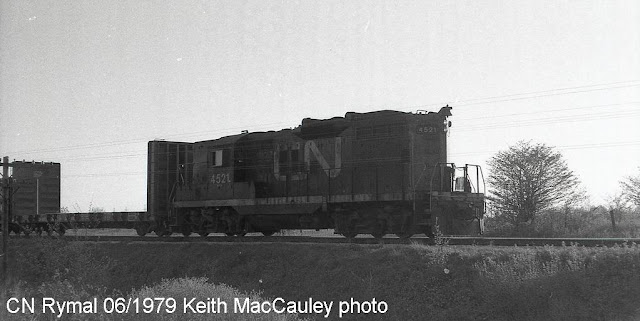
GP9 CN 4521 (GMD London 12/1956) was rebuilt by CN Pointe Ste. Charles as GPRM 7007 in 1985. Following some fifty-seven years (!!!) of service on the home road she would be conveyed to Motive Power Resources Inc. (http://www.mprxinc.com/index.htm) and renumbered MVPX 7007. Doubtful she will enjoy similar longevity with her new owner.

According to on line information, BN 199778 was originally from CB&Q XM-32C series Nos. 18400 – 19399. The 40 Ft. boxcars were constructed by the railroad at their Havelock, Nebraska shops in 1950/1951 from components supplied by Youngstown Steel Door Co. and Standard Railway Equipment. Note the improved Dreadnaught ends with the rectangular top rib. Modifications in a BN rebuild program involved, roof walk removal, shortened ladders, wider 10 Ft. door (w/reinforced opening) and converted roller bearing trucks. Similar to CN 4521, doubtful she enjoyed similar longevity with her second owner.

CN stock car No. 810189 is most likely being used for tie storage and transport - note the haphazard pattern of side strapping repairs and ability to see randomly through the car. This car was from a group of two hundred converted in 1965 from 503500-505850 series wood side (all metal Hutchins roof with Dreadnought steel ends) boxcars. By the early 1980’s Canadian National’s population of stock cars had dwindled to less than 250.

Although the principle CO-OP structures remain, much change to the landscape has occurred over the intervening 36 years. The weed and brush filled field has been consumed by a substantial garden and soil supply enterprise (hence the elevated earthen vantage point). While whitewash has replaced the classic CO-OP cream trimmed by hunter green colour scheme, one can still buy hardware items. However, the only available feed, is for pets.


Lunes, Disyembre 5, 2016

Throwback Thursday 31 CN Goes to Kansas City in 1977


We're in Kansas City, KS, on August 4, 1977, and observe a rather unorthodox consist moving around the west end of ATSF's Argentine yard. Former passenger service U30CG is joined by CN "4115" (GP40 #4015 cleverly disguised to avoid a numbering conflict with with its' lessor), and GP39-2 #3626. While the two more interesting units have long faded into history, the old ATSF 3626 survives as BNSF 2791, and even still wears it's proud ATSF colors (as of February 2016). Uncredited Kodachrome, author's collection.

Tonight’s Throwback Thursday takes us to Santa Fe’s Argentine Yard in Kansas City, KS. It’s August 4, 1977, and we’re at the west end of the yard where we find an unorthodox consist that includes ATSF 8002, a rare U30CG, CN “4115”, a GMD-built GP40, and ATSF 3626, a GP39-2. Interestingly, both CN and ATSF were known for their fondness of six-axle cowl units – CN ordering Bombardier HR-616’s, GMDD SD50F’s and SD60F’s, and GE C40-8M’s, and ATSF acquiring a fleet of new F45’s and FP45’s, U30CG’s, and used SDP40-2F’s from Amtrak (traded for a number of switchers and CF7’s). The U30CG is perhaps a bit more special than the other cowls though, one of only six delivered as ATSF 400-405 in November 1967. Looking sharp in their silver and red Warbonnet paint, their passenger train careers were cut short in February 1969 when a U30CG derailed while leading the Grand Canyon Limited at Chillicothe, IL. The derailment, at least partially, was attributed to the design of the U30CG – a fate the SDP40-2F would later share – and the units demoted to freight service. This meant a repaint, and the standard blue and yellow freight colors now cover the fluted stainless side panels. Evidently, the Santa Fe was short of power in 1977, as evidenced by the CN GP40 in the consist. Actually, the middle unit is CN 4015, temporarily renumbered to avoid a number conflict with ATSF’s fleet of SD39’s at the time also numbered in the 4000-series. CN was no stranger to leasing spare units, and throughout the late 1970’s leased locomotives, primarily GP40’s, SD40’s and even some six-axle MLW’s, to Conrail, ATSF, and L&N. Interestingly, the likelihood that this consist could be repeated would be short-lived. The oddball GE would be traded back to its builder three years after this photo on an order of B36-7’s, meanwhile the GP40 was leased to L&N in 1978. It would eventually be retired by CN by 1998 (likely earlier), and presumably scrapped. Today, the former ATSF 3626 soldiers on as BNSF 2791, interestingly still in the classic ATSF blue and yellow paint scheme as of February 2016 (!). 

The photo below was taken the day after the photo above, ironically, near Canadian, TX. We again see the same cowled U-boat and CN visitor, paired this time with U36C #8789 and a GP20. It seems the ATSF was intent on getting the most out of the borrowed GP40 while they could! In any event, it seems that the summer of 1977 was a good time to be a railfan along the Santa Fe and I'm fortunate to have these interesting images to study.

'Til next time,
Peter.

We're somewhere near Canadian, TX, the day after the photo above and again see our unusual duo sandwiched in an enhanced consist with U36C #8789, and an unidentified GP20. Canadian, TX, is almost 450 miles from Kansas City  - the photographer must have been on an epic railfanning trip to cover that distance in less than two days! Photographer unknown, author's collection.


Miyerkules, Nobyembre 30, 2016

Throwback Thursday 17 CN CP9 4536 at Hamilton Jct


CN 4536 starts up the Cowpath with an eclectic 1980's consist. March 4, 1983, Keith MacCauley photo.


Today's Throwback Thursday features a guest contributor, my dad Keith. Here's his article on some CN GP9 action in the Steel City, back in the day (March 4, 1983). Thanks dad!
- Peter.

In this image we find back to back Canadian National Railways GP9’s Nos. 4536 and 4565 powering a relatively short mixed freight past the CN HAMILTON JCT. sign board as they head northwest (RR east) to merge onto the Dundas Subdivision and exit the ‘Steel City’. In the background above the tank cars is the York Boulevard structure known locally as the ‘High Level Bridge’. Note that 4536 is leading the consist long hood forward as Dick Dilworth intended when he created the legendary EMD GP diesel road switcher platform back in 1949. Perhaps not immediately obvious; the ‘Zebra Stripes’ on No. 4536 have been applied in reverse! (aside from CLC CFA/CPA/CPB’s GMD F/FP’s and MLW FA/FPA’s, the stripes should align on coupled units regardless of operating direction). Spotting features of the mid-production 1957 GMD-built GP9’s are twin 36” fans above each radiator section and a longitudinal fuel tank tucked under the frame between the trucks. Standard CN-issued accessories include the skate style cab roof antenna, below cab hanging re-railers, barrel-style spark arrestors, winterization hatch above the end radiator section, forward mounted bell, MU connections and cross over platforms. Note that 4536’s foot boards are still in place! Trailing the 16-567 powered duo is one of CN’s then-numerous boxcar come caboose (aka ‘van’) created at the mammoth Montreal based Pointe St. Charles facility. Attached to the PSC van are a couple of CN’s modernized 40 ft. boxcars (shortened ladders – no roof walks) and a hodge-podge variety of freight cars. Vans at both ends of the consist most likely imply that the crew has a long afternoon of switching ahead of them in Brantford involving a number of reverse moves requiring crew protection.

Remarkably, the overall scene above is little changed today, although work is currently ongoing that will significantly alter the landscape – a project was recently launched to widen the grade such that a third mainline track can be added adjacent to the bay side right of way. Noteworthy ‘can you spot the differences’ include removal of the maintenance shed (above the first 40 ft. boxcar) and track immediately parallel to 4536 (which actually stub ended a couple hundred yards past the signal). As well, unseen in the distance is enhanced track work under the High Level Bridge added several years ago to bring GO Train service to the former T, H & B Hunter Street station. No doubt the signals shown have been revised and updated.

What has become of the GP9 duo? Incredibly, both are still extant. No. 4536 was remanufactured in 1992 into GP9Rm #7053 by Pt. Ste. Charles and continued to serve her original owner until late 2010. Declared surplus, the unit was sold off and is now part of the Rail Trust Equipment Fleet as RTEX 7053. Wearing her fifth (at least) paint scheme, she is currently dressed in an attractive black with diagonal orange end stripes design (http://www.rrpicturearchives.net/showPicture.aspx?id=3401167). Similarly, 4565 was remanufactured by PSC into GPRM #7231 in 1986 and continues to serve her original owner on Canada’s west coast out of Prince George in central British Columbia. (http://www.rrpicturearchives.net/showPicture.aspx?id=1595368)


Otherwise, the PSC van and 40 ft. boxcars are of course long gone, as would be any unrebuilt freight car from the consist manufactured prior to July 1, 1974 (freight cars built prior to July 1, 1974 are limited to an AAR Interchange life of 40 years, those built after; 50 years). Most likely the steel is still with us, albeit recycled into another form - I wonder if Gillette bought any of the steel from these cars?!

- Keith.

Biyernes, Hulyo 15, 2016

Throwback Thursday 23 CN GP9 4508 at Barrie ON in the Late 1970s


CN GP9 #4508 brings a short wayfreight southward past the Barrie, ON station on a summer's day in the late 1970's. There's just something about the boys sitting on the baggage cart that add an element of timelessness to the photo. Photographer unknown, scan from 35MM Kodak negative from author's collection. 

Tonight’s Throwback Thursday takes us to Barrie, ON, about fourty years ago (the image was scanned from a negative, so actual date is unknown, but we can approximate it to somewhere around 1975-1982). In my opinion, if there was ever an image that captured the essence of railroading in Canada in the late 1970’s or early 1980’s, this shot comes close. There may not be a 52’ bulkhead flatcar in the consist or a VIA consist with “blueline coaches”, but a lot of the other elements that make this a classic CN shot are present: GP9, M420W, 3800 CF cylindrical hopper, Hawker Siddely van, and even a well-maintained passenger station. Each symbols in some way of Canadian railroading at the time, they combine to form a neat little scene that to me is a lot more than just a train in front of a station. The engines, both Canadian-built, CN 4508 and an unidentified MLW M420W exemplify the road’s two paint schemes at the time, the “wet noodle” and “zebra stripe”. A product of a 1961 corporate re-branding, the red, black, and white scheme has endured in some form for over 50 years to the road’s present image (though in my mind, the pinnacle of CN’s motive power aesthetics were achieved in the SD50F). Along with the GP38-2W’s, the M420W’s were the first units delivered with the zebra stripe paint scheme in 1973. A couple of 40’ refer cars trail the locomotives, as well as a 3800 CF cylindrical hopper, also built in Canada by National Steel Car in Hamilton, ON. A popular size with Canadian roads, similar cars were owned by CP, TH&B, Procor, and others. No doubt an HO model would bring a smile to many modelers faces as it is a rather involved kitbash project. Bringing up the markers is a Hawker Siddely CN wide-vision caboose; though it’s difficult to see, the CN noodle centred underneath the cupola point to a Hawker-built van in the CN 79200-79349 series, built 1967, rather than one of the more common Point Ste. Charles cabooses rebuilt at the roads’ Montreal shop from retired 40’boxcars. These cabooses featured vertical cupola faces (instead of slanted), different smoke jack locations, and different battery and equipment box locations than there PSC counterparts. Eric Gagnon has an excellent post about the CN caboose fleet on his Trackside treasure blog here. Some elements of the photo go beyond simply a nice photo from the late 1970’s: the baggage cart, a timeless fixture at many Canadian stations for years, stands at the ready, along with a couple of children who are probably in their 50’s by now! Equally as interesting are the “tickets and information” and “baggage checked here” signs hanging from the station; present day VIA service (which does not include Barrie) is a far cry from the days of simply walking up to the station and buying a ticket for a train operating that day. Other interesting elements: ornate woodworking and windows on the station waiting room, news stand, pay phone (when was the last time you saw one of those?), station sign listing daily departures, and the semaphores (!).

Not much of the scene remains today. CN 4508 would go onto become CN 4024 after emerging from the GP9 rebuild program undertaken at the Point Ste. Charles shops in the 1980’s and 1990’s. Eventually CN 4024 was retired and after languishing at Homewood, IL, the engine was sold to National Railway Equipment where it was likely scrapped or used in a genset conversion. CN’s M420W fleet was off the roster by the late 1990’s, renumbered to the 3500’s as they were transferred to branch line service (and to make way for new GE C44-9WL’s that showed up on the roster in late 1994. The ancient reefers are certainly long gone, in all likelihood falling to the scrapper’s torch, with the same fate probably claiming the hopper and van (though there are a number of 3800 CF hoppers still in service, though not likely many with CN). Barrie now has Monday-Friday commuter service provided by GO Transit, though the station (which still stands) is not used for passenger traffic. Actually, it’s not even Barrie anymore: GO Transit calls it ‘’Allandale Waterfront GO” station. One would in fact be hard-pressed to recognize the station building these days, as it has been considerably re-worked, with new red and tan paint covering the old white-painted wood in the image above. The tracks in the foreground on which the train is resting (once part of the Newmarket subdivision) have also been removed after abandonment in 1996.

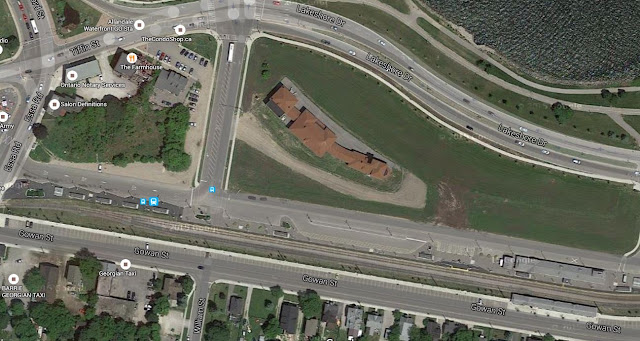
A Google satellite image reveals that the station building still stands, though the tracks on the north side have been removed. The new GO Allandale Waterfront station extends south of the original station building.  
New paint and a clay tile have given the station a completely new look. Despite the effort, it has reportedly sat vacant since 2011. Image from Google Streetview.


But for now, we can reflect back to the late 1970’s when the sun was shining and CN was still running trains through Barrie. And it even looks like I managed to complete this while it’s still Thursday!

‘Til next time,
Cheers,

Peter.

Lunes, Nobyembre 9, 2015

Throwback Thursday 15 CN M420W Action


Somewhere, an MLW salesman must be smiling!


Tonight's Throwback Thursday features a piece by guest author, my dad Keith. As a die-hard Alco (and MLW) fan myself, the M420W is one of my favourite models of locomotive, and a distinctly Canadian prototype. Without further ado, you're up Keith.

Cheers,
Peter.

In a scene that would have pleased an MLW salesman, three M-420 (W)’s (3530/3551/3515) single handedly (triple handedly?) head up a manifest freight with a book ended, albeit grimy, paint scheme configuration. Even 3551 is begrimed despite having been repainted. Unfortunately the date and location of the photo are unknown though a logical guess would be the early to mid-1990’s somewhere in Southern Ontario. Originally delivered in the 2500 number series, the four axle MLW’s enjoyment of the mainline was relatively brief as they were diverted at an early age to secondary service by the incoming hordes of higher horsepower GMD GP40-2 (W)’s. Reduced in weight for their new role by limiting the amount of onboard fuel and sand beginning in 1986, the modified M-420 (W)’s were renumbered into the 3500’s. Note the smaller sized fuel tank on 3530/3551 delivered in the second build group. As part of the MLW purge, all were off the roster by 1998.However, given their bullet proof Alco origin 251 prime mover, many found second homes with several continuing in service to the present.


Trailing unit 3515 was from the initial pioneering build (CN 2500 – 2529 in early 1973), the first series of North American locomotives to be equipped with the so called ‘Crew Comfort Cab’ (Canadian competitor GMD followed MLW’s lead with their version of what ultimately would become the ‘North American’ Cab on GP38-2 (W)5560 later in the year). Continuing the innovation theme, MLW developed a two axle version of their ‘Zero Weight Transfer’ truck. Designated as the ‘ZWT-2’ truck, conventional centerplate/bolster type geometry wasreplaced by a downward (from the frame) yoke and Metalastik pad combination. Unfortunately the lack of traditional springs resulted in the unit’s having a reputation for being rough riders. Unlike the preceding six axle MLW’s, and much more disturbingly, the units also gained a reputation over the years as being somewhat weak pullers. The M420 (W)’s were also noteworthy for launching the so called ‘Zebra Stripe’ paint scheme that would be applied to new power and repaints for almost 20 years. Still far and away my favourite modern era CN locomotive system of locomotive decoration.

- Keith.

Biyernes, Hunyo 5, 2015

Ho iron horse express train set cn


Ho iron horse train set, cn (rnd14262): athearn trains, 10. hobby quality. at athearn, we design our sets to be the basis for a lifelong hobby and only include the best components. this means our train set will last for. Ho scale electric starter sets - lionel train sets, Model trains train sets toy trains trainworld general disclaimer. prices are subject to change without notice. prices in stores may vary.. Ho-trains-mart.com - best prices are here, These goods have sold recently. marklin ho digital premium two train starter set 29845, marklin ho 29247 starter set cl24 mfx sound locomotive train 120v track new.
Yardsale 3 – ho freight – model rr warehouse manufactures, Yardsale ordering information effective 10/1/15. there is no minimum order. there is a minimum shipping and handling charge on yardsale orders. any questions should.
Electric train sets : bachmann trains online store, Bachmann trains online store : electric train sets - catalogs large scale ho scale all scales n scale o scale on30 scale williams 3 rail o scale product lines.
Central hobbies ho scale index page., Track ho scale track comes in various rail heights. code 100. code 100 is the standard size of track included with train sets. we stock the complete atlas code 100.

Ho iron horse express train set cn


Martes, Mayo 5, 2015

Throwback Friday 4 CN 1349 at Thorold in July 1995


CN 1349 heads southward down Pine Street on the Fonthill Spur on July 17, 1995. Reg Button photo, author's collection.

Today’s Throwback Thursday (or as it turns out, now Throwback Friday) features one of the more interesting aspects of railroading: street running. Often mutually unpopular to the local municipality and the railroad, street running is increasingly hard to find. I find that to be a shame, since street running often yields details not otherwise captured in our day-to-day photography, such as the latest model year of a car in the photo, a popular local establishment’s sign, or even fashion trends of people captured in the frame. With that in mind, let’s get to our subject photo.


It’s July 17, 1995, and we find CN SW1200RS #1349 leading two cars up the middle of Pine Street in Thorold, ON. It appears that train #549 has been sent to lift two boxcars from the industry in the background – the Fraser Inc paper mill (now Book Depot). The short train is now heading south down the Fonthill Spur, riding up the small hills that pose little challenge to automobiles and trucks but an interesting challenge to the train. Fraser Inc’s facility was featured in Trevor Marshall’s post (here) on his Achievable Layouts blog and provides many more interesting photos of the plant. At one time it appeared to be quite the industry, handling both outgoing paper loads as well as tank cars of chemicals and hopper cars of additives used in the paper making process. Today, however, the business as well as the street running required to serve the industry are gone, and Pine street is a bit less interesting (to me at least). Street running is not gone altogether from the area though, as CN successor Trillium Railway still uses a small piece of track down the middle of Townline Road to serve Interlake Paper. They even have a CN-painted MLW S-13, required due to sharp curvature on the line. Interestingly, CN 1349 must have liked paper mills as it would go on to be CANX (Canac) 1349, one of the plant switchers at Marathon Pulp in Marathon, ON until the plant closed in 2008. One other interesting aspect of the photo is that it appears Pine Street is in the middle of getting a makeover, judging by the cement truck and dump truck – as the small time capsule of an image has recorded for posterity. 

Cheers,
Peter.

Sabado, Mayo 2, 2015

Throwback Thursday 6 CN SD40 5070 at GMDD London November 1968


CN 5070 sits in the company of an unknown CP SD40 in front of the General Motors Diesel Division plant in London, ON on November 1, 1968. Reg Button photo, author's collection.


Today’s Throwback Thursday takes us back to November 1, 1968. We’re at General Motors Diesel Division (GMDD) in London, Ontario where we find brand new Canadian National SD40 #5070 ready for release. In the background we observe another SD40, although it will go to work for rival Canadian Pacific. How to tell? Close examination reveals a number of differences between CN & CP SD40’s; CP SD40’s featured cab-side rain gutters (not sun shades), snowplow instead of rock plow, a different MU plug arrangement, tight-lock couplers instead of conventional coupler, different air tanks (one large instead of CN’s two smaller tanks on each side) and (especially to modelers), different stairwell (step) arrangements. Another painted CN SD40 off in the distance. Perhaps this is an open house to show off the latest-and-greatest in Canadian motive power? Maybe, but the reason for this interesting pairing of engines may well be lost to history…

About the London plant: General Motors opened the plant at London in late 1950, at a time long before Free Trade permitted easy import of goods to Canada from the US (without costly import tariffs). Facing competition from Montreal Locomotive Works and, to some extent, Fairbanks-Morse (under license to Canadian Locomotive Company), GM constructed the branch plant to supply Canadian roads with new diesels. Toronto, Hamilton & Buffalo GP-7 #71, famously destroyed in a wreck in February 1980 east of Smithville, ON, was the first locomotive completed at the new plant, and was soon to be followed by many more engines for CN, CP, and other Canadian railways. With its’ busiest year in 1958, the overwhelming majority of diesels built for Canadian roads over the next 35 years or so were built in London. When EMD stopped production at its’ primary manufacturing facility in La Grange, IL in 1989, all GM locomotive production was consolidated to the London plant. The plant then handled all production for not only North American railroads, but also did brisk business manufacturing locomotives for export to countries all over the globe. A declining market share, however, eventually lead to the sale of GM-EMD to Greenbriar Equity Group in April 2009, which included the London plant. Run for a number of years under Greenbriar ownership, the former GM-EMD assets were sold in 2010 to Caterpillar Inc. As part of their Progress Rail division, the London plant operated until 2012 when it was shuttered in favour of manufacturing capacity at their new Muncie, IN locomotive plant. The last diesels to be constructed in London were an order of Kansas City Southern SD70Ace’s, with KCS 4130, 4131, 4133, 4135 and 4136 leaving the plant on September 25, 2012, bringing an end to 62 years of locomotive manufacturing in London.

Not only did the plant produce diesel (and even electric) locomotives, but also buses, earth-moving equipment, and military vehicles for GM’s other manufacturing divisions. Though production of busses and earth-moving equipment has long since ended, part of the plant survives under General Dyamics Land Systems ownership and still produces military vehicles.

What about CN 5070? Following its’ release from GMDD London, the engine enjoyed a long career with CN, eventually being repainted into the popular “zebra stripe” scheme. The engine changed little mechanically over the years, eventually gaining a new snowplow and snow shields, along with new horn, ditch lights, winterization hatch and rear rock plow. Though CN initiated a program to rebuild their SD40 fleet in the mid-1990's, it was soon realized that the per-unit rebuild cost was relatively high compared to the cost of purchasing a new unit. Declared surplus, the engine was leased in 1998 to Quebec Railway Corporation for use on the New Brunswick East Coast railway. Less than a year later, the engine was retired in 1999 after 31 years of service. A new lease on life was granted after rebuild by GEC-Alstom in spring 1999 and the engine was released as Chemin de Fer Matapidia et du Golfe (CFMG) #6909 in a solid black paint job. After nine years of operation in southern Quebec, a sale of the QRC operations (CFMG, NBEC and Ottawa Central) to CN in 2008 spelled the end of the line for the engine. Ironically purchased back by its’ original owner, the engine was shipped to the Homewood, IL shop to await disposition. Resold to Allied Services (A division of Allied Equity Group), the engine traveled to Georgianna, AL as ASDX 6909, where it ultimately met the torch.

One has to wonder if CN 5070 and the unknown CP SD40 ever crossed paths again – likely not, but who knows?…

‘Til next time,
Cheers,

Peter.

Lunes, Marso 23, 2015

Follow Up Friday CN 5070 Revisited


I had mentioned to my dad (Keith) that I found surprisingly few photos of CN 5070 despite my research for the Throwback Thursday a few weeks ago that featured a photo of the unit when it was brand new at GMD London in November 1968. Dad then did some further research and put together the first Follow-Up Friday for the blog with some further info on the unit. Here's Keith's second article on the blog - thanks Dad!

- Peter.

I thought it would be interesting to follow 5070 through the years to see what changes may have taken place over time. As Peter indicated, the well designed unit served the original purchaser for some thirty-one years and then went on to toil almost a decade for a second owner. As previously mentioned, the unit was subject to very little cosmetic change, mostly accessories; horns, snow plows, lights and a winterization hatch. No doubt the unit was upgraded electrically fairly early on. EMD’s initial 645 powered 3,000 HP units were known for episodes of terrible wheel slip (more so the B-B units). I believe CN had their in house R&D group help tackle the problem.

Some photos of the more noteworthy changes along the way (author’s collection).


Snow shields and replacement horn (judging by the fresh paint I would speculate that the snow shields have just been added).


Remarkably, the original paint application, albeit touched up, lasted at least a decade. Note the taller forward cooling fan atop the rear of the unit. The horn appears to be mounted on a new bracket and ditch light brackets have been added to the pilot mounted lifting lugs.

Some additional online reference material:

CN 5070
Engine in 1972    (1972)
Engine in 1982 Zebra Stripes    (1982 Zebra Stripe)

CFMG 6069
RR Picture Archives
Traingeek.ca

ASDX 6909
RR Picture Archives

- Keith

Huwebes, Setyembre 11, 2014

Throwback Thursday 3 CN 7025 Switching at Rymal in May 1993


CN 7025 has come north from Caledonia for some switching at Rymal near the end of the line - literally and figuratively - in 1993. Norm Conway photo, author's collection.

Today’s Throwback Thursday is a little close to home – in fact, only a couple of miles from my house. Here is a shot of CN GP9Rm #7025 (one of my favourite geeps) switching the Rymal Spur at Rymal in July 1993. In addition to a passing track at the co-op north of Rymal road (Highway 53 to Hamiltonians), two spurs south of the highway served a lumber dealer and Shaw Pipe. The local here is switching either of the latter industries, although it is probable that it is Shaw Pipe, based on the number of cars in the view. Shaw pipe applied specialized coatings to pipe and shipped a lot of out by rail, until rail service ended on the spur. In addition to the Stelco Steel train, the line at one time hosted a through local based out of Hamilton, commonly operating with a set of SW1200RS’s. Shaw had only a single spur with capacity for only a few cars at a time, so during large contracts switching was handled twice a day, by both the local as well as another operating north from Caledonia.


I say spur, although the track was once the Hagersville subdivision on CN (the original one, though the present day Hagersville sub starts at Brantford, not Hamilton). A few run-ins between trucks and the bridge over Stone Church Road  sounded the death knell for the line as a through route. It's steep mountain climb, risky street running, light traffic base and it's existence as essentially duplicate trackage finally conspired against it. The final time damaged the bridge to the point it was condemned, and placed on the track next to where the overpass stood, about a mile south of the Rymal station sign. From this point on, the line existed briefly as the Rymal  spur originating in Caledonia and served on an as-needed basis by a local likely stationed at Caledonia or Brantford. Which brings us to our subject photo – a rare one at that; the line was seldom photographed once the Hamilton-Nanticoke Stelco Steel train was routed via the Dundas sub to Brantford and from there down the new Hagersville sub to its’ lakeside destination. Alas, a few carloads a week to Shaw Pipe and the odd car to the lumberyard proved insufficient to maintain the spur and it was abandoned in 1993 and the rails taken up not long after. 

Cheers,
Peter.

Linggo, Hulyo 6, 2014

Throwback Thursday 19 CN at Rymal Part II


Tonight's Throwback Thursday features the second half of my Dad Keith's write-up of the namesake location for this blog. Thanks again Dad!
- Peter.

As mentioned in the previous Rymal anecdote, the former Hamilton and Northwestern Railway line would cling to life into the early 1990’s, finally succumbing to abandonment in 1993. However, the line did not vanish without a final blaze of glory!


Towards the end, the lightly-traversed branchline was a bastion of venerable CNR road power, including the long serving mainstay GMD SW1200’s, GMD GP9’s as well as the occasional MLW RS-18. However, as shown above, the most noteworthy and beloved units by far were the handful of CN’s infamous remaining snow service GMD F7’s. With no on-route switching demands, the F7 A/B consists were ideally suited to the inter-plant traffic pattern requirements of ‘The Steel Company of Canada’, aka ‘Stelco’, transporting continuously-cast slabs from their newer flagship facility in Nanticoke to the rolling mills located at Hilton Works, situated on the Hamilton waterfront. For an all-too-brief period, pure A-B-A sets as shown, and on occasion F7’s mixed with GP9’s ferried 60 ft flatcars, equipped with specialized slab cradles, from lakefront (actually Hamilton Harbour/Lake Ontario) to lakefront (Lake Erie). While more than a delight for the local railfan community (See ‘F Units on the Nanticoke/CN 9100’s produced by Green Frog Productions, www.greenfrog.comshot by area enthusiast Rob McCormack), some operational concerns were voiced.  Lower city dwellers became increasingly concerned about the potential for a loaded runaway slab train descending the escarpment without brakes, careening through their community. This, despite the fact that the line had crested the geographical outcrop in the mid 1870’s and had been disaster free for well over a century! As the unlikely catastrophe dialogue was heating up, the matter was resolved by an unforeseen event when the bridge over Stone Church Road (located approximately under the trailing caboose) was displaced by an over-height transport truck – see photo below. Owing to the compromised structural integrity of the span, rail traffic was suspended south from CN’s Stuart St. yard (the alternative, much more circuitous routing, involved movement from Stuart St. yard to Brantford along the Dundas sub, then back to Caledonia to rejoin the former H&NW line). As if to add an exclamation point, the span was displaced in the opposite direction, shortly thereafter, by another unfortunate truck encounter. This time the injured bridge span was lifted and placed perpendicular on the right of way! As previously mentioned, much of the H&NW chartered line remains as the ‘STONE CHURCH ROAD RAIL TRAIL’. North of Stone Church Road the former right of way is known as the ‘ESCARPMENT RAIL TRAIL’. One can walk or ride their bike past them, but no longer does the sound of normally-aspirated 567's echo off the concrete silo walls...

- Keith.

Above: Atop the escarpment, as shown, the H&NW chartered line descended to the first station stop at Rymal. No doubt longer freight trains would have been a challenge for the hogger with part of his consist ascending and part descending at the same time! For additional information on the ‘Hamilton and Northwestern Railway’ refer to Charles Cooper’s superb manuscript entitled ‘RAILS TO THE LAKES’. Reportedly, creating the path to climb from the lower city was accomplished by Irish labourers ("navvies", displaced canal builders) over a three year period at a cost of approximately one million 1870’s dollars! A modern day remnant of their efforts is the downtown ‘Cork Town’ community, so named on account of their off duty shenanigans! Apparently construction of Hamilton’s first jails more or less accompanied the building of the H&NW!


Above: Late local area business development did generate a limited amount of additional activity on the line. Shown on the below are CN 603042 and DWC 605628, Canadian-built 52’-8” bulkhead flatcars (see the October 1990 issue of Railroad Model Craftsman Magazine for drawings and additional background) on the Rymal siding. The duo is loaded with drywall for ‘Ferrell Builders Supply’ an area materials provider. The concrete grain silo structure in the foreground is believed to have been constructed just prior to World War II, several years ahead of the adjacent CO-OP installation. The silo complex was built by the owner of the neighbouring Binbrook Feed Mill operation. Storage space was also leased to other enterprises, including the nearby Hannon Feed Mill. Operation of the silo complex would have most likely continued into the mid 1960’s, just prior to the widespread use of large volume covered hopper cars for grain transport. The low volume operation was set up for boxcar grain delivery. Undoubtedly, the improved highway system and truck transport rendered the facility redundant to local area needs. Incredibly, the concrete structure is still sound with the interior mostly preserved - the vertical wooden bucket elevator and much of the original woodwork are still solidly in place. It’s like the owner just walked away one day!


Lunes, Abril 14, 2014

Get Cn ho train set


For Free Cn ho train set

Train sets only train sets, model railroad, and wooden, Train sets only is the source for all your n, ho, o, and g scale model railroad & wooden railway needs.. Ho scale electric starter sets - lionel train sets, Model trains train sets toy trains trainworld general disclaimer. prices are subject to change without notice. prices in stores may vary.. Depot ho scale trains, ho train sets inventory (216) 252, Depot ho scale trains, ho train sets inventory generated 8/27/2015 all items subject to prior sale. home page/index accurate lighting (acl) accurail inc (acr.
Just train crazy - model railroading model trains ontario, About us all of us here at "just train crazy" are knowledgeable and experienced model railroaders with layouts of our own - so we really do understand your needs!.
Yardsale 1 – ho motive power – model rr warehouse, Yardsale ordering information effective 10/1/15. there is no minimum order. there is a minimum shipping and handling charge on yardsale orders. any questions should.
Central hobbies ho scale index page., Track ho scale track comes in various rail heights. code 100. code 100 is the standard size of track included with train sets. we stock the complete atlas code 100.
There are four reasons why you must know Cn ho train set Find here about Cn ho train set it is not easy to obtain this information Before going further I found the following information was related to Cn ho train set a bit review

Pictures Cn ho train set


Amazon.com: HO Freight Hauler Train Set, CN TLT857001: Toys & Games

Huwebes, Marso 13, 2014

Throwback Thursday err Friday! 22 CN Stuart Street Yard Over the Years by Keith MacCauley


I started this post when it was Thursday, but the night seemed to get away from me, so maybe we'll call this a "flashback Friday" instead... Anyway, tonight's post features another article by my dad, Keith. It's one that I had been wanting to write for a long time, but he beat me to it! I hope to expand on it in the future, though I don't have any set time frame for doing so - one of those "someday" projects. Over to you now Keith.

- Peter.


Classic 1970's Canadian railroading in the Steel City: MLW switcher, tank cars with a "flying P" logo on them, and lots of cars with friction bearing trucks.
In the above photo, we find CN S-4 8169 (MLW 9/1956) shown sorting a quartet of tank cars at the Bay Street end of the Hamilton-located Stuart Street Yard. Nose-coupled to the veteran switcher are a trio of non-insulated 20,000 gallon (US) tank cars along with an underframe style tank car emblazoned ‘AIR LIQUIDE’. The scene is a wonderful synopsis of ‘traditional’ railroading (technically in Canada it would be ‘railwaying’, but this sounds silly!): flat switching, end cab switchers, forty foot boxcars, and of course, cabooses (or ‘vans’ in Canada). Note the cupola on the second car on the rip track.

In just over three years Canadian National would embark upon a mammoth upgrade/rebuild program on its vast GP9 fleet at their Pointe St. Charles facility that would ultimately eschew the likes of 8169 and brethren. CN 8169 would soldier on long enough to receive updated 1973 decoration with an all-orange cab (http://www.rrpicturearchives.net/showPicture.aspx?id=3438358), but would be set aside out of service in the early 1980’s. Seemingly, except for maintenance, the old girl never wandered away from Hamilton, prior to her demise.
The non-insulated tank cars are nominal 70-ton capacity (220,000 lbs total Gross Rail Load) most likely constructed in the late 1960’s/early 1970’s. Tank cars of this size and style (so called ‘non-pressure’, non-insulated equipped with hinged & bolted manway cover and bottom outlet valve) would primarily have been deployed in gasoline and diesel fuel-, or other similar-density flammable liquid service. Similar to the S-4, bigger and better technology in the form of 30,000 gallon/100 ton (263,000 lbs total Gross Rail Load) capacity would usurp their duties and eventually render them obsolete, though not as rapidly.

Note the track parts along the path beside the occupied track and materials stacked to the right of the rip track and the collection of maintenance structures in the background. Shortly, the City of Hamilton would embark upon a bay front revitalization initiative and change the surrounding landscape forever.

Stay tuned for future instalments; see below for some plot spoilers!

- Keith.

Fast-forward nearly 40 years: the MLW's, and in fact the CN itself are nearly gone from Stuart Street, replaced instead by EMD's owned by RailAmerica, and operated by the Southern Onrario Railway. Shortly RailAmerica would be acquired by Genesee & Wyoming, bringing a wave of orange and yellow paint to the shortline. 
RLK 4001 was originally constructed by EMD in August of 1959 as Southern Pacific No. 5872. Renumbered to 3708 in 1965, the built as low nose unit would be conveyed to the Central Western Railway and then onto the Lakeland and Waterways Railway, enterprises both located in the province of Alberta. Leaving Western Canada in 2002, the well-travelled locomotive has spent the last decade on the Goderich-Exeter Railway prior to arriving in Hamilton on the Southern Ontario Railway.


Sabado, Marso 1, 2014

Throwback Thursday 26 CN Plow Run at Hamilton ON March 1984


A late-winter storm has called for a plow extra on the Grimsby sub. Here CN RS-18 #3624 pushes plow #55219 eastbound near Parkdale on March 1, 1984. Reg Button photo, author's collection.


Tonight’s Throwback Thursday takes us back to March 1984. We’re at Hamilton, ON on the first day of the month, where we find an eastbound plow run on the CN Grimsby sub near Parkdale. As if that’s not interesting enough, the power for this plow run is RS-18 #3624. Plow runs on the CN in Ontario were synonymous with CN’s bastion of F7Au’s, some of which specially modified for this purpose. As the F’s aged, however, backup snow-fighting power was facilitated by modifying a number of RS18’s and GP9’s with distinctive “snow shields” which stymied snow incursion into the fans and radiators. Interestingly enough, CN 3624 wasn’t one of them. Even more unusual is a plow run on the Grimsby sub – far more typical on CN’s branchline network north of London, the sight of a snowplow on the double track Grimsby sub mainline is indeed unusual (I wonder if CN had any double-track plows left in 1984?). Hamilton is not typically affected by winter storms to the same degree as the Toronto area or southwestern Ontario, but the Niagara peninsula does have a habit of attracting some pretty major snowfalls. So it was likely that somewhere farther east this unusual movement would encounter a bit more resistance than the trip has already dealt the plow. Any way one looks at it, however, it is quite an interesting occurrence – one of “if it hadn’t been photographed, I wouldn’t believe it” trains! Interestingly, the photographer noted “first time on the Grimsby sub” on the slide mount. I don’t know whether that’s accurate or not, but it almost certainly hasn’t been repeated since. CN 3624 itself had a fairly long career, having been built in 1957 by MLW. Aside from a repaint from the CN noodle scheme to the zebra-stripe scheme, it seems that the unit lead a generally uneventful life, reaching the Moncton deadlines by 1990, and likely scrapped shortly thereafter. But for a least one day, it must have been pretty exciting to have been at the throttle in that engine…

‘Til next time,
Cheers,

Peter.