Ipinapakita ang mga post na may etiketa na 1968. Ipakita ang lahat ng mga post

Huwebes, Agosto 20, 2015

Throwback Thursday 2 DRGW 3071 at Minturn CO July 1968


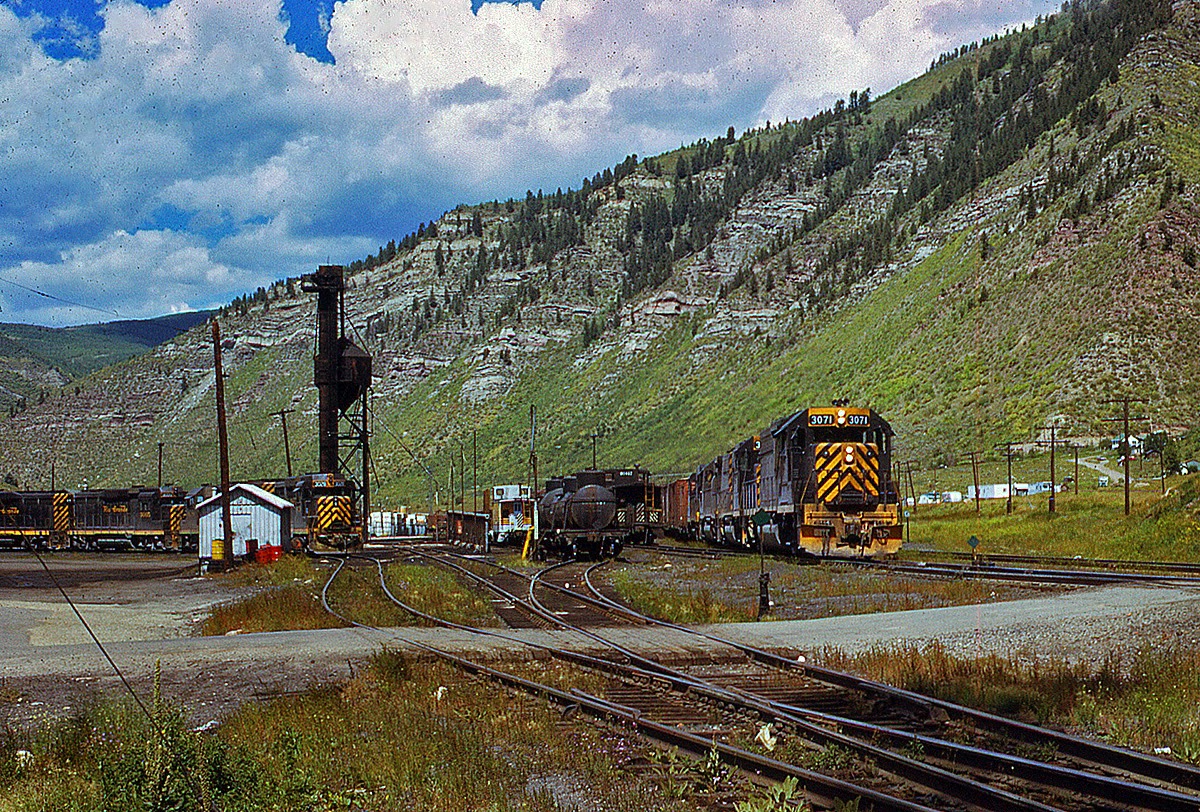
DRGW GP40 #3071 pauses at Minturn, CO in July 1968. John W. Maxwell photo, author's collection.

One hobby of mine is collecting and trading 35mm photographic slides of trains and railroad equipment. Last year, I acquired a small part of the photographic collection of John W. Maxwell, a photographer well-known among the narrow gauge community in the western United States. From the information I could gather, John was a mechanical engineer who was employed by Union Pacific in Colorado. I believe he lived in Denver, although that is only a guess based upon where the bulk of the photos were taken. John was popular among narrow gauge enthusiasts for his extensive photography of narrow gauge equipment and for making highly accurate scale drawings of narrow gauge rolling stock and equipment. John took photos for over 60 years, and from what I can find on the internet, the location of the bulk of his photographic and drawings collection remains a mystery. But instead of dwelling on where the collection went, let’s enjoy the view he captured in the photo above.

We’re at Minturn, Colorado in July 1968 – the sanding tower in the photo easily recognizable to any fan of The Mainline Through the Rockies. In this view we find one-and-a-half year old GP40 #3071 leading an eastbound that has stopped at the yard.  Minturn is located on the west side of the infamous Tennessee Pass, and is a town long associated – and closely tied to – the railroad. It was here that nearly all eastbound trains stopped and had helpers added to the train in order to overcome the 3% grades further up the pass. Though the train is eastbound, the tracks here run almost north-south allowing for good lighting of eastbounds almost all day long; it appears to be perhaps late morning at this click of the shutter. By this point in time, the 26 SD45’s are all on the property, but the railroad is still largely dominated by turbocharged four-axle locomotives, as evidenced by the consist of this train as well as the power in the distance. It would be another six years before the tunnel motors synonymous with the DRGW in its’ later years would show up, and we’re still not quite into EMD’s Dash-2 era yet
. We can safely surmise that the three GP30’s and a unit hidden by the shed are a helper set that perhaps will cut in partway back in this train, or another eastbound later in the day. Between the two lashups are no less than four (!) GP30’s along with an equal number of GP40’s or GP35’s. What a sound it must have been to hear this train leave town!

The lead unit, DRGW 3071 would go onto have a long and interesting history (most information from Don Strack’s Utah Rails site). It was the third of twelve GP40’s delivered to the Rio Grande in early 1967, and one of many high-horsepower four axle units that the railroad owned. The unit was converted into a trailing-only unit (“B-unit”) in 1972 with the removal of the radio, cab seats and other lead-required equipment; 24 other GP40’s and a number of GP30’s and GP35’s were similarly modified in an effort to reduce operating costs. The engine remained in this condition for many years and into the Southern Pacific era, when it was returned to a lead-capable unit. Eight years after the Rio Grande – Southern Pacific merger in 1988, the engine became part of the massive Union Pacific system in 1996. Under UP ownership, the engine left home rails and travelled far from its’ Tennessee Pass rails in the photo above. Photos on the internet reveal it travelled at least as far as Houston, TX and North Little Rock, AR. Ownership by UP lasted only five years, and in May 2001 the engine was retired after 34 years of service. A sale the next year to National Railway Equipment the following year took the engine to Silvis, IL, where the unit became a donor for one of the NRE’s many rebuild programs. Eventually, this unit was rebuilt by NRE, emerging as BNSF 2013 in late 2006 or early 2007. No longer a GP40, the locomotive is now mechanically a GP38-2, including a 16-645E non-turbocharged prime mover, oil-bath air filter box, new electrical gear, and just two radiator fans (the middle one was removed in the rebuild). A testament to EMD design, the engine should be around for many more years to come, having outlived its’ original owner and even Tennessee Pass itself.

 I am grateful to John Maxwell for taking the time and effort to record this scene on film – in future posts I will share more of the slides acquired from his collection.

‘Til next time,

Cheers,

Peter.

Sabado, Mayo 2, 2015

Throwback Thursday 6 CN SD40 5070 at GMDD London November 1968


CN 5070 sits in the company of an unknown CP SD40 in front of the General Motors Diesel Division plant in London, ON on November 1, 1968. Reg Button photo, author's collection.


Today’s Throwback Thursday takes us back to November 1, 1968. We’re at General Motors Diesel Division (GMDD) in London, Ontario where we find brand new Canadian National SD40 #5070 ready for release. In the background we observe another SD40, although it will go to work for rival Canadian Pacific. How to tell? Close examination reveals a number of differences between CN & CP SD40’s; CP SD40’s featured cab-side rain gutters (not sun shades), snowplow instead of rock plow, a different MU plug arrangement, tight-lock couplers instead of conventional coupler, different air tanks (one large instead of CN’s two smaller tanks on each side) and (especially to modelers), different stairwell (step) arrangements. Another painted CN SD40 off in the distance. Perhaps this is an open house to show off the latest-and-greatest in Canadian motive power? Maybe, but the reason for this interesting pairing of engines may well be lost to history…

About the London plant: General Motors opened the plant at London in late 1950, at a time long before Free Trade permitted easy import of goods to Canada from the US (without costly import tariffs). Facing competition from Montreal Locomotive Works and, to some extent, Fairbanks-Morse (under license to Canadian Locomotive Company), GM constructed the branch plant to supply Canadian roads with new diesels. Toronto, Hamilton & Buffalo GP-7 #71, famously destroyed in a wreck in February 1980 east of Smithville, ON, was the first locomotive completed at the new plant, and was soon to be followed by many more engines for CN, CP, and other Canadian railways. With its’ busiest year in 1958, the overwhelming majority of diesels built for Canadian roads over the next 35 years or so were built in London. When EMD stopped production at its’ primary manufacturing facility in La Grange, IL in 1989, all GM locomotive production was consolidated to the London plant. The plant then handled all production for not only North American railroads, but also did brisk business manufacturing locomotives for export to countries all over the globe. A declining market share, however, eventually lead to the sale of GM-EMD to Greenbriar Equity Group in April 2009, which included the London plant. Run for a number of years under Greenbriar ownership, the former GM-EMD assets were sold in 2010 to Caterpillar Inc. As part of their Progress Rail division, the London plant operated until 2012 when it was shuttered in favour of manufacturing capacity at their new Muncie, IN locomotive plant. The last diesels to be constructed in London were an order of Kansas City Southern SD70Ace’s, with KCS 4130, 4131, 4133, 4135 and 4136 leaving the plant on September 25, 2012, bringing an end to 62 years of locomotive manufacturing in London.

Not only did the plant produce diesel (and even electric) locomotives, but also buses, earth-moving equipment, and military vehicles for GM’s other manufacturing divisions. Though production of busses and earth-moving equipment has long since ended, part of the plant survives under General Dyamics Land Systems ownership and still produces military vehicles.

What about CN 5070? Following its’ release from GMDD London, the engine enjoyed a long career with CN, eventually being repainted into the popular “zebra stripe” scheme. The engine changed little mechanically over the years, eventually gaining a new snowplow and snow shields, along with new horn, ditch lights, winterization hatch and rear rock plow. Though CN initiated a program to rebuild their SD40 fleet in the mid-1990's, it was soon realized that the per-unit rebuild cost was relatively high compared to the cost of purchasing a new unit. Declared surplus, the engine was leased in 1998 to Quebec Railway Corporation for use on the New Brunswick East Coast railway. Less than a year later, the engine was retired in 1999 after 31 years of service. A new lease on life was granted after rebuild by GEC-Alstom in spring 1999 and the engine was released as Chemin de Fer Matapidia et du Golfe (CFMG) #6909 in a solid black paint job. After nine years of operation in southern Quebec, a sale of the QRC operations (CFMG, NBEC and Ottawa Central) to CN in 2008 spelled the end of the line for the engine. Ironically purchased back by its’ original owner, the engine was shipped to the Homewood, IL shop to await disposition. Resold to Allied Services (A division of Allied Equity Group), the engine traveled to Georgianna, AL as ASDX 6909, where it ultimately met the torch.

One has to wonder if CN 5070 and the unknown CP SD40 ever crossed paths again – likely not, but who knows?…

‘Til next time,
Cheers,

Peter.