Ipinapakita ang mga post na may etiketa na Rymal. Ipakita ang lahat ng mga post

Sabado, Disyembre 24, 2016

Throwback Thursday 18 CN GP9 4521 at Rymal Siding Part 1


Tonight's Throwback Thursday features another article by my Dad, Keith. I've been meaning to explain the significance of why I named this blog "Rymal Station" (can't recall if I have already), but hopefully this will help explain it. Part 2 to follow. Thanks Dad!

- Peter.

CN GP9 #4521 at Rymal in 1979


An early summer evening finds a pocket-sized Canadian National wayfreight pausing to retrieve an empty bulkhead flatcar from the CO-OP siding at Rymal, situated in the Southern Ontario hamlet of Hannon. Hannon, while not a locality ever identified on any map, was situated just above the Niagara Escarpment on Hamilton Mountain (as referred to by ‘Hamiltonians’). The CNR branchline is the former Hamilton and Northwestern Railway ROW built to link Hamilton with the Lake Erie community of Port Dover. After coupling up and performing the requisite brake test, the tidy consist will trundle northward, cautiously descend along the previously-mentioned geographical feature, cross over the T, H & B main line and swing onto Ferguson Avenue to do some street running prior to entering Stuart Street yard located along the Hamilton waterfront. Out of frame, at the head end is CN GP9 4521, with the following consist in tow:
- bulkhead flat car (CN 606000 series)
- 89 ft flat car (CN 668091 – built 12/1975)
- 40 ft single door boxcar (BN 199778)
- 40 ft livestock car (CN 810189)
- 50 ft MOW tie gondola (CN 60223)
- Pointe St. Charles Caboose (CN 79800 series)

The collection of buildings (except for the cylindrical concrete silos located behind the tall structure on the right) is part of what once was known as the ‘Ancaster CO-OP’. Constructed in the mid 1940’s following the conclusion of WW II hostilities, the farm, feed and hardware supply enterprise was geographically misnamed by design. The long term plan by the original share contributing owners was to relocate to the neighboring named community once an alternative to rail supplied raw materials could be organized. No doubt the expanding local highway system and truck transport were the anticipated methodology. However, such plans never materialized and today, after serving in their original intended purpose for decades, the structures shown still exist and have been incorporated into a thriving Home Hardware installation.


The fate of the Canadian National branchline? Despite a daily Hamilton-Nanticoke steel slab train that gained the line fame in its' later days, the former H&NW line suffered from diminishing traffic into the early 1990’s, and would eventually be lifted in 1993. Service south from Hamilton would be suspended in the late 1980’s following the lateral displacement of the Stone Church road overpass (in both directions!) by transport truck collision. Today, much of the ROW remains as the ‘STONE CHURCH ROAD RAIL TRAIL’.

Stay tuned for Part 2 to follow.
- Keith.
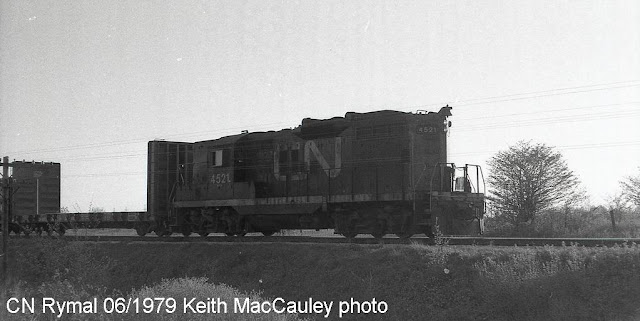
GP9 CN 4521 (GMD London 12/1956) was rebuilt by CN Pointe Ste. Charles as GPRM 7007 in 1985. Following some fifty-seven years (!!!) of service on the home road she would be conveyed to Motive Power Resources Inc. (http://www.mprxinc.com/index.htm) and renumbered MVPX 7007. Doubtful she will enjoy similar longevity with her new owner.

According to on line information, BN 199778 was originally from CB&Q XM-32C series Nos. 18400 – 19399. The 40 Ft. boxcars were constructed by the railroad at their Havelock, Nebraska shops in 1950/1951 from components supplied by Youngstown Steel Door Co. and Standard Railway Equipment. Note the improved Dreadnaught ends with the rectangular top rib. Modifications in a BN rebuild program involved, roof walk removal, shortened ladders, wider 10 Ft. door (w/reinforced opening) and converted roller bearing trucks. Similar to CN 4521, doubtful she enjoyed similar longevity with her second owner.

CN stock car No. 810189 is most likely being used for tie storage and transport - note the haphazard pattern of side strapping repairs and ability to see randomly through the car. This car was from a group of two hundred converted in 1965 from 503500-505850 series wood side (all metal Hutchins roof with Dreadnought steel ends) boxcars. By the early 1980’s Canadian National’s population of stock cars had dwindled to less than 250.

Although the principle CO-OP structures remain, much change to the landscape has occurred over the intervening 36 years. The weed and brush filled field has been consumed by a substantial garden and soil supply enterprise (hence the elevated earthen vantage point). While whitewash has replaced the classic CO-OP cream trimmed by hunter green colour scheme, one can still buy hardware items. However, the only available feed, is for pets.


Huwebes, Setyembre 11, 2014

Throwback Thursday 3 CN 7025 Switching at Rymal in May 1993


CN 7025 has come north from Caledonia for some switching at Rymal near the end of the line - literally and figuratively - in 1993. Norm Conway photo, author's collection.

Today’s Throwback Thursday is a little close to home – in fact, only a couple of miles from my house. Here is a shot of CN GP9Rm #7025 (one of my favourite geeps) switching the Rymal Spur at Rymal in July 1993. In addition to a passing track at the co-op north of Rymal road (Highway 53 to Hamiltonians), two spurs south of the highway served a lumber dealer and Shaw Pipe. The local here is switching either of the latter industries, although it is probable that it is Shaw Pipe, based on the number of cars in the view. Shaw pipe applied specialized coatings to pipe and shipped a lot of out by rail, until rail service ended on the spur. In addition to the Stelco Steel train, the line at one time hosted a through local based out of Hamilton, commonly operating with a set of SW1200RS’s. Shaw had only a single spur with capacity for only a few cars at a time, so during large contracts switching was handled twice a day, by both the local as well as another operating north from Caledonia.


I say spur, although the track was once the Hagersville subdivision on CN (the original one, though the present day Hagersville sub starts at Brantford, not Hamilton). A few run-ins between trucks and the bridge over Stone Church Road  sounded the death knell for the line as a through route. It's steep mountain climb, risky street running, light traffic base and it's existence as essentially duplicate trackage finally conspired against it. The final time damaged the bridge to the point it was condemned, and placed on the track next to where the overpass stood, about a mile south of the Rymal station sign. From this point on, the line existed briefly as the Rymal  spur originating in Caledonia and served on an as-needed basis by a local likely stationed at Caledonia or Brantford. Which brings us to our subject photo – a rare one at that; the line was seldom photographed once the Hamilton-Nanticoke Stelco Steel train was routed via the Dundas sub to Brantford and from there down the new Hagersville sub to its’ lakeside destination. Alas, a few carloads a week to Shaw Pipe and the odd car to the lumberyard proved insufficient to maintain the spur and it was abandoned in 1993 and the rails taken up not long after. 

Cheers,
Peter.

Sabado, Agosto 30, 2014

Introduction Why Rymal Station


Hello All!

This is the first post in my new blog so I’d like to introduce myself and the aim of this blog. My name is Peter and I have been interested in trains as long as I can remember. Part of that interest, a large part in fact, includes model railroading. My interest is in modern-day CN and CP operations, with some shortline modeling as well (GEXR, OSR). I have been reading several other model railroad blogs for some time now and it has inspired me to start my own. Hence, the idea of this blog is to document the progress on my home layout, as well as some prototype photos as well. 

I say ‘my’ home layout, but in fact it was started by my dad about 20 years ago. He designed most of the track plan, and completed the benchwork and the majority of the track work. My brother Mark and I are now working with dad to complete the trackwork and at the same time convert the layout to DCC. I’ll post more info and a track plan later, but hopefully this brings you up to speed with where I’ll start this blog. I hope in the foreseeable future to get the trackwork running reliably and start adding some scenery to the layout.

Why Rymal station?

Well, the short answer is that I had to call this blog something. The long answer is that it seems many modelers name their layout or blog after something meaningful to them or their modeling. Rymal was a small hamlet on the south edge of Hamilton, ON, and bears the name of William Rymal, an early settler of the area; it has long since been amalgamated with the city of Hamilton. Rymal, sometimes referred to as Dartnall or Hannon, was important enough to warrant a station on the CNR line from Hamilton to Jarvis (originally Hamilton & Lake Erie; I’ll post more info on the station itself later). This was the line made famous for its’ street running down the middle of Ferguson Ave in Hamilton, and later the use of an A-B-A set of F7’s on the Hamilton-Nanticoke steel train; again, more info to be posted on the steel train later on. My house is located about four miles from where the station stood, and my dad grew up less than a mile from the station’s location (though it was demolished about three years before he was born). And at one time many years ago, my great-grandfather ran the Rymal feed mill (actually named Ancaster feed mill for reasons long lost to history), and would bring in boxcars of grain to the siding at Rymal for use as animal feed. So not only was it geographically the closest rail point of interest, but in some strange way it seems to make sense.

I’ll try to update this blog as often as time permits, but until then, thanks for stopping by!

Cheers,

Peter.

Linggo, Hulyo 6, 2014

Throwback Thursday 19 CN at Rymal Part II


Tonight's Throwback Thursday features the second half of my Dad Keith's write-up of the namesake location for this blog. Thanks again Dad!
- Peter.

As mentioned in the previous Rymal anecdote, the former Hamilton and Northwestern Railway line would cling to life into the early 1990’s, finally succumbing to abandonment in 1993. However, the line did not vanish without a final blaze of glory!


Towards the end, the lightly-traversed branchline was a bastion of venerable CNR road power, including the long serving mainstay GMD SW1200’s, GMD GP9’s as well as the occasional MLW RS-18. However, as shown above, the most noteworthy and beloved units by far were the handful of CN’s infamous remaining snow service GMD F7’s. With no on-route switching demands, the F7 A/B consists were ideally suited to the inter-plant traffic pattern requirements of ‘The Steel Company of Canada’, aka ‘Stelco’, transporting continuously-cast slabs from their newer flagship facility in Nanticoke to the rolling mills located at Hilton Works, situated on the Hamilton waterfront. For an all-too-brief period, pure A-B-A sets as shown, and on occasion F7’s mixed with GP9’s ferried 60 ft flatcars, equipped with specialized slab cradles, from lakefront (actually Hamilton Harbour/Lake Ontario) to lakefront (Lake Erie). While more than a delight for the local railfan community (See ‘F Units on the Nanticoke/CN 9100’s produced by Green Frog Productions, www.greenfrog.comshot by area enthusiast Rob McCormack), some operational concerns were voiced.  Lower city dwellers became increasingly concerned about the potential for a loaded runaway slab train descending the escarpment without brakes, careening through their community. This, despite the fact that the line had crested the geographical outcrop in the mid 1870’s and had been disaster free for well over a century! As the unlikely catastrophe dialogue was heating up, the matter was resolved by an unforeseen event when the bridge over Stone Church Road (located approximately under the trailing caboose) was displaced by an over-height transport truck – see photo below. Owing to the compromised structural integrity of the span, rail traffic was suspended south from CN’s Stuart St. yard (the alternative, much more circuitous routing, involved movement from Stuart St. yard to Brantford along the Dundas sub, then back to Caledonia to rejoin the former H&NW line). As if to add an exclamation point, the span was displaced in the opposite direction, shortly thereafter, by another unfortunate truck encounter. This time the injured bridge span was lifted and placed perpendicular on the right of way! As previously mentioned, much of the H&NW chartered line remains as the ‘STONE CHURCH ROAD RAIL TRAIL’. North of Stone Church Road the former right of way is known as the ‘ESCARPMENT RAIL TRAIL’. One can walk or ride their bike past them, but no longer does the sound of normally-aspirated 567's echo off the concrete silo walls...

- Keith.

Above: Atop the escarpment, as shown, the H&NW chartered line descended to the first station stop at Rymal. No doubt longer freight trains would have been a challenge for the hogger with part of his consist ascending and part descending at the same time! For additional information on the ‘Hamilton and Northwestern Railway’ refer to Charles Cooper’s superb manuscript entitled ‘RAILS TO THE LAKES’. Reportedly, creating the path to climb from the lower city was accomplished by Irish labourers ("navvies", displaced canal builders) over a three year period at a cost of approximately one million 1870’s dollars! A modern day remnant of their efforts is the downtown ‘Cork Town’ community, so named on account of their off duty shenanigans! Apparently construction of Hamilton’s first jails more or less accompanied the building of the H&NW!


Above: Late local area business development did generate a limited amount of additional activity on the line. Shown on the below are CN 603042 and DWC 605628, Canadian-built 52’-8” bulkhead flatcars (see the October 1990 issue of Railroad Model Craftsman Magazine for drawings and additional background) on the Rymal siding. The duo is loaded with drywall for ‘Ferrell Builders Supply’ an area materials provider. The concrete grain silo structure in the foreground is believed to have been constructed just prior to World War II, several years ahead of the adjacent CO-OP installation. The silo complex was built by the owner of the neighbouring Binbrook Feed Mill operation. Storage space was also leased to other enterprises, including the nearby Hannon Feed Mill. Operation of the silo complex would have most likely continued into the mid 1960’s, just prior to the widespread use of large volume covered hopper cars for grain transport. The low volume operation was set up for boxcar grain delivery. Undoubtedly, the improved highway system and truck transport rendered the facility redundant to local area needs. Incredibly, the concrete structure is still sound with the interior mostly preserved - the vertical wooden bucket elevator and much of the original woodwork are still solidly in place. It’s like the owner just walked away one day!