Ipinapakita ang mga post na may etiketa na Throwback. Ipakita ang lahat ng mga post

Martes, Enero 24, 2017

Throwback Thursday 25 Canadian Pacific DT 2 Switcher at Goderich ON in July 1964


Canadian Pacific DT-2 44-ton centercab switcher #17 work the grain elevators at Goderich, Ontario in July 1964. Except maybe for gloves, it doesn't look like there was much PPE back in 1964! CP's impressive bridge over the Maitland River can be seen in the distance at left. Uncredited Kodachrome from author's collection.

Tonight’s Throwback Thursday takes us back to July 1964 in Goderich, ON, where we find Canadian Pacific DT-2 switcher #17 switching grain boxcars. A seldom-photographed engine, CP owned 14 of these unusual little diesel-hydraulic locomotives, scattered around the system for light switching duties. The engines were built by Canadian Locomotive Company of Kingston, ON from 1957-1960, but were not a Fairbanks-Morse design, as were most diesels that CLC built. Instead, two Caterpillar D-337 engines each contributed 250 hp, routed to the inboard axles of each truck, and from there to the outboard axles by means of crank rods. A rather bold departure from the rest of CP’s diesel roster, the units proved to be somewhat of a pariah, with retirements occurring as early as 1969. Built in 1959, CP #17 replaced 0-6-0 #6275 (noteworthy as the last operating 0-6-0 on CP’s system) , itself surviving on the CP roster until a sale to Cambridge, Ontario boiler and steam energy equipment maker Babcock & Wilcox in 1974. Another sale in 1996 took the unit to Tottenham, ON where it served as a parts source for South Simcoe Railway’s other DT-2, #22. Briefly reunited with one of the few remaining DT-2’s, #17 was stripped of usable parts and eventually scrapped in 2006 once it had outlived its’ usefulness.

While photographs of CP operations in Goderich often feature the small lakefront yard or the adjacent passenger station, the grain elevators seem to have been seldom photographed. The namesake of the 111.8 mile branchline CP used to reach the town, Goderich was important enough to warrant two railroads, CN being the other line to serve the town. Salt, grain, Champion road graders (later Volvo Construction Equipment), and other industries in town contributed to the majority of the railway’s business in the town.  Gradually though, trucks and centralized manufacturing eroded much of the industry served by CN and CP, with the latter abandoning the Goderich subdivision north (west) of Guelph in 1989. In 1992, the competition also pulled out of Goderich, with CN selling the line west of Stratford to new Railtex operator Goderich-Exeter Railway. The Sifto Salt mine located on the waterfront is now the largest industry served in Goderich by GEXR. Changes in grain rates made Ontario grain less favourable in comparison to that grown on the prairies, and many Lake Huron ports including Goderich, Owen Sound, and Collingwood, faced reduced grain volumes (or a complete halt in grain shipments altogether), a problem made worse for the railroads by stiff competition from trucks. Goderich, however, faired better than some other ports, and Goderich Eleveators continues to send grain out by ship primarily to the export market. Both trucks and the GEXR serve the elevators, though modern 4650 CF cylindrical hoppers are a far cry from strings of 40’ boxcars!

Interestingly, both CP #6275 and the former CP steel bridge over the Maitland River survive today. Old #6275 resides indoors at the Huron County Pioneer Museum, never having left the city it served for many years. The bridge is now a part of a hiking trail and offers a unique view of the port and Maitland River.
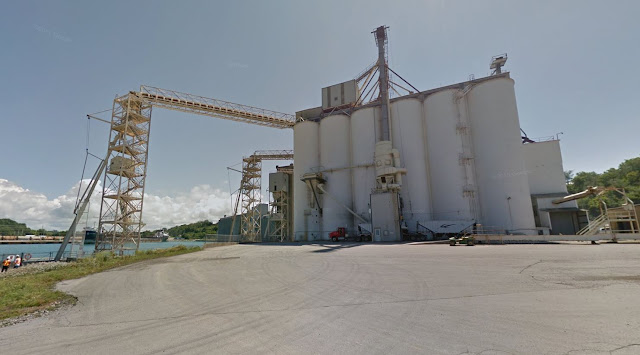
A Google Streetview image in approximately the same area as our subject photo. This elevator is no longer served by rail (trucks only), though the elevator in the distance still has rail service.

A Google satellite shot of the port of Goderich, as well as the town's unique octagonally-arranged historic downtown core. The old CP line extends in an arc down and to the left from top-center, while the ex-CN (now GEXR) line extends left-right across the image to reach the Sifto Salt mine at left.


‘Til next time,
Cheers,

Peter.

Huwebes, Enero 5, 2017

Throwback Thursday 24 CP RS18 8773 at Hamilton ON in October 1978


CP RS18 #8773, still with it's 5" stripes on the cab face, pauses at Hamilton, ON in October 1978 with a rather unusual consist. Uncredited Kodachrome, author's collection.

Tonight’s Throwback Thursday takes us back to October 1978, at Hamilton, ON. We’re at the classic art-deco TH&B station, located near the downtown core on Hunter Street. Today it is a hub of GO Transit activity, but back on this day in 1978 it played host to a rather unusual train consisting of CP RS18 #8773, a CP steel caboose #434257, an Amtrak sleeper/combination car, and a TH&B heavyweight passenger car. What was this strange train doing at the station? Good question. There was no information on the slide mount, however the sequence of shots from this day shows the train at Toronto Union Station, here at Hamilton, and finally at the TH&B yard in Welland. At Welland, the engine and van were wyed and coupled to the back of an Amtrak train. While the reason for this odd operation may be lost to history, it may have been a director’s special of some sort. The Toronto-Hamilton-Welland routing is interesting, as it the mix of equipment – perhaps a joint effort by the TH&B’s parent companies, CP and Penn Central? Hopefully at least one other railfan was out that day and made notes on this train – this was of course, long before the days of email or facebook, where sharing of railfan information involved actually talking to someone else, in person or over the phone.

Interestingly, except perhaps for the station building, not much from this scene remains today. CP 8773, constructed in 1958 at MLW, was later rebuilt to RS-18u #1827 in 1985 at the company’s Angus shops in Montreal. The unit operated until 1992 when it was destroyed in a wreck at Mile 35.3 of CP’s Sherbrooke subdivision. Retirement followed in 1993, and finally scrapping at Winnipeg, MB in June 1994. Likewise, it’s probable that the CP van, Amtrak sleeper, and the TH&B heavyweight coach have all likely met the same fate. But at least we have this recollection of another one of those oddities that always seem to happen on cloudy days.

‘Til next time,
Cheers,

Peter.

Sabado, Disyembre 24, 2016

Throwback Thursday 18 CN GP9 4521 at Rymal Siding Part 1


Tonight's Throwback Thursday features another article by my Dad, Keith. I've been meaning to explain the significance of why I named this blog "Rymal Station" (can't recall if I have already), but hopefully this will help explain it. Part 2 to follow. Thanks Dad!

- Peter.

CN GP9 #4521 at Rymal in 1979


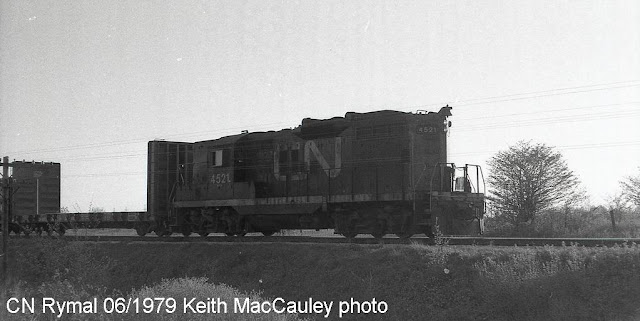
An early summer evening finds a pocket-sized Canadian National wayfreight pausing to retrieve an empty bulkhead flatcar from the CO-OP siding at Rymal, situated in the Southern Ontario hamlet of Hannon. Hannon, while not a locality ever identified on any map, was situated just above the Niagara Escarpment on Hamilton Mountain (as referred to by ‘Hamiltonians’). The CNR branchline is the former Hamilton and Northwestern Railway ROW built to link Hamilton with the Lake Erie community of Port Dover. After coupling up and performing the requisite brake test, the tidy consist will trundle northward, cautiously descend along the previously-mentioned geographical feature, cross over the T, H & B main line and swing onto Ferguson Avenue to do some street running prior to entering Stuart Street yard located along the Hamilton waterfront. Out of frame, at the head end is CN GP9 4521, with the following consist in tow:
- bulkhead flat car (CN 606000 series)
- 89 ft flat car (CN 668091 – built 12/1975)
- 40 ft single door boxcar (BN 199778)
- 40 ft livestock car (CN 810189)
- 50 ft MOW tie gondola (CN 60223)
- Pointe St. Charles Caboose (CN 79800 series)

The collection of buildings (except for the cylindrical concrete silos located behind the tall structure on the right) is part of what once was known as the ‘Ancaster CO-OP’. Constructed in the mid 1940’s following the conclusion of WW II hostilities, the farm, feed and hardware supply enterprise was geographically misnamed by design. The long term plan by the original share contributing owners was to relocate to the neighboring named community once an alternative to rail supplied raw materials could be organized. No doubt the expanding local highway system and truck transport were the anticipated methodology. However, such plans never materialized and today, after serving in their original intended purpose for decades, the structures shown still exist and have been incorporated into a thriving Home Hardware installation.


The fate of the Canadian National branchline? Despite a daily Hamilton-Nanticoke steel slab train that gained the line fame in its' later days, the former H&NW line suffered from diminishing traffic into the early 1990’s, and would eventually be lifted in 1993. Service south from Hamilton would be suspended in the late 1980’s following the lateral displacement of the Stone Church road overpass (in both directions!) by transport truck collision. Today, much of the ROW remains as the ‘STONE CHURCH ROAD RAIL TRAIL’.

Stay tuned for Part 2 to follow.
- Keith.

GP9 CN 4521 (GMD London 12/1956) was rebuilt by CN Pointe Ste. Charles as GPRM 7007 in 1985. Following some fifty-seven years (!!!) of service on the home road she would be conveyed to Motive Power Resources Inc. (http://www.mprxinc.com/index.htm) and renumbered MVPX 7007. Doubtful she will enjoy similar longevity with her new owner.

According to on line information, BN 199778 was originally from CB&Q XM-32C series Nos. 18400 – 19399. The 40 Ft. boxcars were constructed by the railroad at their Havelock, Nebraska shops in 1950/1951 from components supplied by Youngstown Steel Door Co. and Standard Railway Equipment. Note the improved Dreadnaught ends with the rectangular top rib. Modifications in a BN rebuild program involved, roof walk removal, shortened ladders, wider 10 Ft. door (w/reinforced opening) and converted roller bearing trucks. Similar to CN 4521, doubtful she enjoyed similar longevity with her second owner.

CN stock car No. 810189 is most likely being used for tie storage and transport - note the haphazard pattern of side strapping repairs and ability to see randomly through the car. This car was from a group of two hundred converted in 1965 from 503500-505850 series wood side (all metal Hutchins roof with Dreadnought steel ends) boxcars. By the early 1980’s Canadian National’s population of stock cars had dwindled to less than 250.

Although the principle CO-OP structures remain, much change to the landscape has occurred over the intervening 36 years. The weed and brush filled field has been consumed by a substantial garden and soil supply enterprise (hence the elevated earthen vantage point). While whitewash has replaced the classic CO-OP cream trimmed by hunter green colour scheme, one can still buy hardware items. However, the only available feed, is for pets.


Lunes, Disyembre 5, 2016

Throwback Thursday 31 CN Goes to Kansas City in 1977


We're in Kansas City, KS, on August 4, 1977, and observe a rather unorthodox consist moving around the west end of ATSF's Argentine yard. Former passenger service U30CG is joined by CN "4115" (GP40 #4015 cleverly disguised to avoid a numbering conflict with with its' lessor), and GP39-2 #3626. While the two more interesting units have long faded into history, the old ATSF 3626 survives as BNSF 2791, and even still wears it's proud ATSF colors (as of February 2016). Uncredited Kodachrome, author's collection.

Tonight’s Throwback Thursday takes us to Santa Fe’s Argentine Yard in Kansas City, KS. It’s August 4, 1977, and we’re at the west end of the yard where we find an unorthodox consist that includes ATSF 8002, a rare U30CG, CN “4115”, a GMD-built GP40, and ATSF 3626, a GP39-2. Interestingly, both CN and ATSF were known for their fondness of six-axle cowl units – CN ordering Bombardier HR-616’s, GMDD SD50F’s and SD60F’s, and GE C40-8M’s, and ATSF acquiring a fleet of new F45’s and FP45’s, U30CG’s, and used SDP40-2F’s from Amtrak (traded for a number of switchers and CF7’s). The U30CG is perhaps a bit more special than the other cowls though, one of only six delivered as ATSF 400-405 in November 1967. Looking sharp in their silver and red Warbonnet paint, their passenger train careers were cut short in February 1969 when a U30CG derailed while leading the Grand Canyon Limited at Chillicothe, IL. The derailment, at least partially, was attributed to the design of the U30CG – a fate the SDP40-2F would later share – and the units demoted to freight service. This meant a repaint, and the standard blue and yellow freight colors now cover the fluted stainless side panels. Evidently, the Santa Fe was short of power in 1977, as evidenced by the CN GP40 in the consist. Actually, the middle unit is CN 4015, temporarily renumbered to avoid a number conflict with ATSF’s fleet of SD39’s at the time also numbered in the 4000-series. CN was no stranger to leasing spare units, and throughout the late 1970’s leased locomotives, primarily GP40’s, SD40’s and even some six-axle MLW’s, to Conrail, ATSF, and L&N. Interestingly, the likelihood that this consist could be repeated would be short-lived. The oddball GE would be traded back to its builder three years after this photo on an order of B36-7’s, meanwhile the GP40 was leased to L&N in 1978. It would eventually be retired by CN by 1998 (likely earlier), and presumably scrapped. Today, the former ATSF 3626 soldiers on as BNSF 2791, interestingly still in the classic ATSF blue and yellow paint scheme as of February 2016 (!). 

The photo below was taken the day after the photo above, ironically, near Canadian, TX. We again see the same cowled U-boat and CN visitor, paired this time with U36C #8789 and a GP20. It seems the ATSF was intent on getting the most out of the borrowed GP40 while they could! In any event, it seems that the summer of 1977 was a good time to be a railfan along the Santa Fe and I'm fortunate to have these interesting images to study.

'Til next time,
Peter.

We're somewhere near Canadian, TX, the day after the photo above and again see our unusual duo sandwiched in an enhanced consist with U36C #8789, and an unidentified GP20. Canadian, TX, is almost 450 miles from Kansas City  - the photographer must have been on an epic railfanning trip to cover that distance in less than two days! Photographer unknown, author's collection.


Miyerkules, Nobyembre 30, 2016

Throwback Thursday 17 CN CP9 4536 at Hamilton Jct


CN 4536 starts up the Cowpath with an eclectic 1980's consist. March 4, 1983, Keith MacCauley photo.


Today's Throwback Thursday features a guest contributor, my dad Keith. Here's his article on some CN GP9 action in the Steel City, back in the day (March 4, 1983). Thanks dad!
- Peter.

In this image we find back to back Canadian National Railways GP9’s Nos. 4536 and 4565 powering a relatively short mixed freight past the CN HAMILTON JCT. sign board as they head northwest (RR east) to merge onto the Dundas Subdivision and exit the ‘Steel City’. In the background above the tank cars is the York Boulevard structure known locally as the ‘High Level Bridge’. Note that 4536 is leading the consist long hood forward as Dick Dilworth intended when he created the legendary EMD GP diesel road switcher platform back in 1949. Perhaps not immediately obvious; the ‘Zebra Stripes’ on No. 4536 have been applied in reverse! (aside from CLC CFA/CPA/CPB’s GMD F/FP’s and MLW FA/FPA’s, the stripes should align on coupled units regardless of operating direction). Spotting features of the mid-production 1957 GMD-built GP9’s are twin 36” fans above each radiator section and a longitudinal fuel tank tucked under the frame between the trucks. Standard CN-issued accessories include the skate style cab roof antenna, below cab hanging re-railers, barrel-style spark arrestors, winterization hatch above the end radiator section, forward mounted bell, MU connections and cross over platforms. Note that 4536’s foot boards are still in place! Trailing the 16-567 powered duo is one of CN’s then-numerous boxcar come caboose (aka ‘van’) created at the mammoth Montreal based Pointe St. Charles facility. Attached to the PSC van are a couple of CN’s modernized 40 ft. boxcars (shortened ladders – no roof walks) and a hodge-podge variety of freight cars. Vans at both ends of the consist most likely imply that the crew has a long afternoon of switching ahead of them in Brantford involving a number of reverse moves requiring crew protection.

Remarkably, the overall scene above is little changed today, although work is currently ongoing that will significantly alter the landscape – a project was recently launched to widen the grade such that a third mainline track can be added adjacent to the bay side right of way. Noteworthy ‘can you spot the differences’ include removal of the maintenance shed (above the first 40 ft. boxcar) and track immediately parallel to 4536 (which actually stub ended a couple hundred yards past the signal). As well, unseen in the distance is enhanced track work under the High Level Bridge added several years ago to bring GO Train service to the former T, H & B Hunter Street station. No doubt the signals shown have been revised and updated.

What has become of the GP9 duo? Incredibly, both are still extant. No. 4536 was remanufactured in 1992 into GP9Rm #7053 by Pt. Ste. Charles and continued to serve her original owner until late 2010. Declared surplus, the unit was sold off and is now part of the Rail Trust Equipment Fleet as RTEX 7053. Wearing her fifth (at least) paint scheme, she is currently dressed in an attractive black with diagonal orange end stripes design (http://www.rrpicturearchives.net/showPicture.aspx?id=3401167). Similarly, 4565 was remanufactured by PSC into GPRM #7231 in 1986 and continues to serve her original owner on Canada’s west coast out of Prince George in central British Columbia. (http://www.rrpicturearchives.net/showPicture.aspx?id=1595368)


Otherwise, the PSC van and 40 ft. boxcars are of course long gone, as would be any unrebuilt freight car from the consist manufactured prior to July 1, 1974 (freight cars built prior to July 1, 1974 are limited to an AAR Interchange life of 40 years, those built after; 50 years). Most likely the steel is still with us, albeit recycled into another form - I wonder if Gillette bought any of the steel from these cars?!

- Keith.

Miyerkules, Nobyembre 16, 2016

Correction to Throwback Thursday 12 Mingo Jct OH not Sayre PA


A very helpful reader of the blog pointed out a glaring error I made in last week's Throwback Thursday - the location of the photos is actually Mingo Junction, Ohio, not Sayre, PA. The slide mount does say Sayre PA on it, but I can only surmise that the photographer made a typo in his notes that day. We were only off by 300 miles!

But this actually brings me to another related topic - one of the reasons I started this blog was to interact with, and share tips/tricks/knowledge among other railfans and modelers. So I'm glad that my mistakes are pointed out (and moreover, that people are actually reading my posts!) - I'd rather have accurate photo descriptions than look like some half-baked know-it-all. And if anyone notices errors in my future posts (no doubt there will be some), please let me know - I welcome the comments or info you have to share. 

Stay tuned for some upcoming posts on recent HO work in the next couple of weeks. 

Cheers,
Peter.

PS: Thanks Scot!

Huwebes, Setyembre 22, 2016

Throwback Thursday 28 CP Winter Action at Galt 1972 2014


The low winter sun illuminates CP C424 #4238 as it is about to pass the depot at Galt with an extra westbound in February 1972. Chuck Begg photo, author's collection.

The same view as above, 42 years later (3 January 2014). The MLW's are long gone, replaced by an ES44AC and a SD40-2 (also now gone). No longer is this location Galt, but now the city of Cambridge - unless you're a railfan, in which case this will always be Galt!


Today’s Throwback Thursday takes us back to the Winter of 1972. We’re at Galt, ON, standing in front of the CP depot that still bears the name of its’ Scottish novelist namesake (John Galt). A year later, the civic merger of Galt, Preston, and Hespeler would result in the city of Cambridge, where the modern counterpart photo was taken (even though I’m standing essentially where photographer Chuck Begg did 42 years earlier, I’m in another city!).

In this view, we see a CP westbound extra lead by three MLW C424’s, with the lead unit #4238 still in it’s as-delivered classic Tuscan and grey paint scheme. The unit is seven years old, built in 1965, and would survive another three years before being repainted to CP’s attractive Action Red paint scheme in early 1975. The engine would serve its original owner for 33 years until a sale in 1998 to New Brunswick East Coast Railway took the unit to the Maritimes. As Alco/MLW technology faded from the shortline scene, the unit was sold for parts to sister railroad Ottawa Central before being scrapped in March 2004.

Not only are the Burlington Route boxcar and the head-end stock cars long gone, but the scene itself has changed substantially as well. Absent in Chuck’s photo is the #8 highway/Dundas St. bridge constructed over the Galt yard and Galt Sub mainline. Auto traffic now dominates activity in the yard with a Toyota manufacturing plant located on the old Grand River Railway line a few miles north of the yard (the line merges into the yard near the Burlington boxcar on the other side of Samuelson street). 

Though the scene has changed, Galt is still a busy place with several through freights and a daily local passing through on the main line. A pair of locals based at Wolverton yard east of Woodstock also call on the yard, heading up the old GRR line (CP Waterloo spur) to serve the Toyota plant. Additionally, the station and freight shed still stand, so it’s still possible to relive the scene in Chuck’s photo – too bad the MLW’s are gone though!

‘Til next time,
Cheers,
Peter.


Linggo, Setyembre 11, 2016

Throwback Thursday 29 Bayview Memories by Keith


A while back I had a Throwback Thursday about the changes over the years at CN's Bayview Jct, in Hamilton ON. Turns out I 'scooped' my dad who was coincidentally writing a similar article at the same time. So today is part II of our Bayview documentary, written by my dad Keith. 

'Til next time,
Cheers,
Peter.

Bayview Flashback


On a clear mid spring evening freshly painted Canadian Pacific SD40's 5541 and 5514 are about to duck under the Royal Botanical Garden's Laking Gardens pedestrian bridge as they pass through Bayview Jct. and lead the ‘Starlite’ mixed freight towards Burlington, Ontario. The named freight is a carryover from the days of the Toronto, Hamilton and Buffalo Railway, by this date a fallen flag having been fully absorbed by co-parent CP two years previously. Decades-old trackage rights permitted the competitor movement along Canadian National's historic Oakville Subdivision. However, nothing lasts forever and CP's trackage rights would expire approximately twenty years hence.

The right of way that the train is traversing was originally that of the Great Western Railway and dates from the mid 1800’s. In the distant background directly above the lead locomotive is the Desjardins Canal, sadly the scene of one of Canada’s first passenger train tragedies. On the evening of March 12th 1857, as a Great Western passenger train approached the canal  swing bridge, a broken axle on the locomotive caused the consist to plummet some six stories to the frozen waters below. Some fifty nine souls were lost in the calamity, including renowned railway contractor and banker Samuel Zimmerman. A fixed replacement rail bridge replaced the destroyed movable span, preventing the passage of ocean-going schooners through the canal. In time, a consequence of that decision would be the reversal of Dundas’ industrial prominence over Hamilton in the Great Lakes shipping trade. The four-posted highway bridge in the background, known locally as the High Level bridge, was constructed in 1932 by the city of Hamilton as part of a western entrance beautification/depression era unemployment relief program.

In order to accommodate the extra mainline track the width of the supporting berm was increased and then stabilized with a series of piles along the base of the embankment at the water line. Note that the cantilevered signal mast near the cross-overs has been removed in the interim.


While the overall harbor view remains relatively unchanged decades on, the area's railway infrastructure has been substantially enhanced. In 2006 a third main track, extending westward to the junction was added to the harbor side of the existing double track right of way. Currently, in conjunction with expanded GO Train service to Hamilton and beyond, the third main is being extended further westward. Ongoing activity at the moment is focused upon an addition to the bridge structure spanning the historic Desjardins Canal.

As for the locomotives in the lead photo, CP SD40 5514 was built by GMD London in 1966. The unit was upgraded to SD40-2 specifications and equipped with Q-Tron electronics (to enhance tractive effort) prior to sale to the Dakota, Minnesota and Eastern Railroad, becoming DME 6081. The new owner would subsequently upgrade the venerable unit to -3 electronics. In something of an ironic twist, CP would re-acquire the survivor, included in its acquisition of the regional road. Likewise, CP 5541 was also built at the London facility, in 1967. Similarly upgraded to SD40-2 specifications the unit’s fate would be far less auspicious; retired in 2001 and subsequently sold for scrap in 2005.

- Keith.

Mission accomplished. To further stabilize the man made addition, the geographical feature was immediately hydro-seeded. Note the substantial pile structure along the water line. Note also the natural grown in appearance of the vegetation shown in the photo below. Over time, the view (possible photo angles) on one side of the junction has improved, while the other (west side) view has been obliterated all together by the vegetation.


Note the start of some low-level vegetation on the hillside at left - how long until those trees obscure the view again?

Miyerkules, Agosto 24, 2016

Throwback Thursday 14 TH B GP7 77 at Guelph Junction July 18 1984


The CP/TH&B Goderich Turn pauses while switching with TH&B 77 &401 at Guelph Juntion, near Campbellville, ON, on July 18, 1984. Reg Button photo, author's collection.
Today’s Throwback Thursday takes us back to July 18, 1984; it’s late in the day at Guelph Junction, located 39.2 miles up the Galt Sub from Toronto. Guelph Junction is an interesting place on the Galt Sub, and is the location where the Hamilton Sub joins the Galt Sub (from the south) and where the Goderich sub branches off northward to Guelph (cut back from Goderich in the late 1980’s). What remains of the Goderich Sub is owned by the city of Guelph (the only municipally-owned common carrier railway line in Canada) and now operated by shortline Ontario Southland Railway. Interestingly, the two branches are not directly connected to each other, but a pair of wyes (facing north and south) are used to bring trains on or off the Hamilton/Goderich subdivisions. Guelph Junction also marks the end of CTC territory originating in Toronto, and where OCS track warrant territory continues another 74 miles to London (except for CTC islands at Wolverton and London). A GO transit storage facility was located here for a number of years, used to store GO commuter trainsets used on the Milton line in the evenings or on weekends. Discontinued a few years ago when a new layover facility was constructed in Milton, use of the yard is now confined to OSR/CP interchange to the shortline. At one time, the Goderich sub featured a daily-except-Sunday passenger train from Hamilton to Goderich, usually powered by one of the road’s quaint 4-4-4 Jubilee engines, and included an unusual reverse move at the junction to cross the Galt sub (northward train would pull around south wye, back down the Galt sub, and carry on northward around the north wye and onto Goderich). If a Jubilee wasn’t available, or if the regular engine broke down, a spare engine stationed at the junction would be used to power the local passenger train. Often this was a P-1 or P-2 Mikado, which made for quite the interesting little passenger train! Additional passenger service was provided by a CP gas-electric doodlebug based out of Guelph, and often made several round trips between Guelph and the junction (about 15 miles) per day.

Through the viewfinder, we observe a pair of TH&B geeps, GP7 #77 and GP9 #401. The subject train (though apparently absent of cars this day) is the Goderich Turn, operated north out of TH&B’s Aberdeen yard to its’ namesake port on Lake Huron. An interesting operation, the train commonly operated with TH&B-supplied power, often with just a single unit. This is especially interesting considering the steep descent down the Niagara Escarpment from Guelp Junction and the TH&B units’ lack of dynamic brakes. The pair of units on today’s train is an interesting anomaly, considering TH&B’s common practice of using borrowed engines to power its’ own trains. It appears that the train is making a switching move at the time of this photo – note the conductor with his large shoulder-slung radio appears to have just lined the main line switch back to the normal position. Most of what is visible in this photo is now gone – the CP Chevy van undoubtedly disposed of after years of service, and the station demolished to make way for additional GO Transit storage tracks, the TH&B geeps, and even the train order semaphore, a Guelph Junction landmark for decades. But for at least a moment back in July 1984 we can imagine what the geeps’ 567 engines sounded like while switching at the Junction.

‘Til next time,

Cheers,
Peter.

Linggo, Agosto 14, 2016

Last Throwback Thursday of 2015 December 31 2015


This goes back to January 23rd 2007 and our first snowfall(very late) of the 06-07 winter.  This test train was in Remington, VA on Norfolk Southern.  A very ACL looking locomotive.  Even got the pic in Railpace Magazine.


Martes, Agosto 2, 2016

Throwback Thursday


I'm hopefully going to do this new Thursday theme every Thursday.  I'm going to find a picture (or pictures) of the layout or model and post it on here.  Hopefully I can find one for each week!  I should be getting back into the swing of things in the coming days and weeks.  Got 2 medium size changes for the layout and will talk about them in another post.  So here we go with Throwback Thursday, VMID style:
Know where this is on the layout? This the corner leading into Battlefield Yard.  This is from Jan. 09 and on the left is the track leading down to the lower level.  Very steep grade and it was eventuall ripped out for an On30 layout.

This GP40 #299 that I still have.  She was was the first locomotives to receive the green and gray of the VMID.  This is the original scheme.  I put working front ditchlights that were an absolute pain in it.  After that I decided to "move" out of the ditchlight era.  It's sitting near Old Dominion Foods area with no scenery.  Jan. 2009.


Biyernes, Hulyo 15, 2016

Throwback Thursday 23 CN GP9 4508 at Barrie ON in the Late 1970s


CN GP9 #4508 brings a short wayfreight southward past the Barrie, ON station on a summer's day in the late 1970's. There's just something about the boys sitting on the baggage cart that add an element of timelessness to the photo. Photographer unknown, scan from 35MM Kodak negative from author's collection. 

Tonight’s Throwback Thursday takes us to Barrie, ON, about fourty years ago (the image was scanned from a negative, so actual date is unknown, but we can approximate it to somewhere around 1975-1982). In my opinion, if there was ever an image that captured the essence of railroading in Canada in the late 1970’s or early 1980’s, this shot comes close. There may not be a 52’ bulkhead flatcar in the consist or a VIA consist with “blueline coaches”, but a lot of the other elements that make this a classic CN shot are present: GP9, M420W, 3800 CF cylindrical hopper, Hawker Siddely van, and even a well-maintained passenger station. Each symbols in some way of Canadian railroading at the time, they combine to form a neat little scene that to me is a lot more than just a train in front of a station. The engines, both Canadian-built, CN 4508 and an unidentified MLW M420W exemplify the road’s two paint schemes at the time, the “wet noodle” and “zebra stripe”. A product of a 1961 corporate re-branding, the red, black, and white scheme has endured in some form for over 50 years to the road’s present image (though in my mind, the pinnacle of CN’s motive power aesthetics were achieved in the SD50F). Along with the GP38-2W’s, the M420W’s were the first units delivered with the zebra stripe paint scheme in 1973. A couple of 40’ refer cars trail the locomotives, as well as a 3800 CF cylindrical hopper, also built in Canada by National Steel Car in Hamilton, ON. A popular size with Canadian roads, similar cars were owned by CP, TH&B, Procor, and others. No doubt an HO model would bring a smile to many modelers faces as it is a rather involved kitbash project. Bringing up the markers is a Hawker Siddely CN wide-vision caboose; though it’s difficult to see, the CN noodle centred underneath the cupola point to a Hawker-built van in the CN 79200-79349 series, built 1967, rather than one of the more common Point Ste. Charles cabooses rebuilt at the roads’ Montreal shop from retired 40’boxcars. These cabooses featured vertical cupola faces (instead of slanted), different smoke jack locations, and different battery and equipment box locations than there PSC counterparts. Eric Gagnon has an excellent post about the CN caboose fleet on his Trackside treasure blog here. Some elements of the photo go beyond simply a nice photo from the late 1970’s: the baggage cart, a timeless fixture at many Canadian stations for years, stands at the ready, along with a couple of children who are probably in their 50’s by now! Equally as interesting are the “tickets and information” and “baggage checked here” signs hanging from the station; present day VIA service (which does not include Barrie) is a far cry from the days of simply walking up to the station and buying a ticket for a train operating that day. Other interesting elements: ornate woodworking and windows on the station waiting room, news stand, pay phone (when was the last time you saw one of those?), station sign listing daily departures, and the semaphores (!).

Not much of the scene remains today. CN 4508 would go onto become CN 4024 after emerging from the GP9 rebuild program undertaken at the Point Ste. Charles shops in the 1980’s and 1990’s. Eventually CN 4024 was retired and after languishing at Homewood, IL, the engine was sold to National Railway Equipment where it was likely scrapped or used in a genset conversion. CN’s M420W fleet was off the roster by the late 1990’s, renumbered to the 3500’s as they were transferred to branch line service (and to make way for new GE C44-9WL’s that showed up on the roster in late 1994. The ancient reefers are certainly long gone, in all likelihood falling to the scrapper’s torch, with the same fate probably claiming the hopper and van (though there are a number of 3800 CF hoppers still in service, though not likely many with CN). Barrie now has Monday-Friday commuter service provided by GO Transit, though the station (which still stands) is not used for passenger traffic. Actually, it’s not even Barrie anymore: GO Transit calls it ‘’Allandale Waterfront GO” station. One would in fact be hard-pressed to recognize the station building these days, as it has been considerably re-worked, with new red and tan paint covering the old white-painted wood in the image above. The tracks in the foreground on which the train is resting (once part of the Newmarket subdivision) have also been removed after abandonment in 1996.

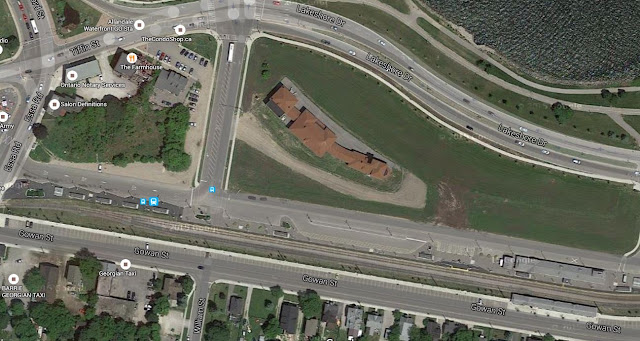
A Google satellite image reveals that the station building still stands, though the tracks on the north side have been removed. The new GO Allandale Waterfront station extends south of the original station building.  
New paint and a clay tile have given the station a completely new look. Despite the effort, it has reportedly sat vacant since 2011. Image from Google Streetview.


But for now, we can reflect back to the late 1970’s when the sun was shining and CN was still running trains through Barrie. And it even looks like I managed to complete this while it’s still Thursday!

‘Til next time,
Cheers,

Peter.

Biyernes, Hulyo 1, 2016

Throwback Thursday November 3rd 2016


It's fall so it's time for a fall-like throwback.  Even though it's 80 degrees today, the leave changing is in full effect around here.  In Mance, PA, home of the Ex- B&O between Cumberland and Pittsburgh, was a place I took a yearly trip in the second week of October.  As most trees weren't even close, up on the summit, the maples were reds/yellows and rest were close.  Never got there during peak colors because the weather is dreary most days and would pick the most appealing days to camp out.  It was quite cold at night with lows in the 30s/40s. But worth it every second when you get pics like this from October 2005:


Linggo, Mayo 15, 2016

Throwback Thursday 9 Passenger Action at Bayview in February 1977


Competitors meet at Bayview on a cold Winter's day in February 1977. Uncredited Kodachrome, author's collection.

Today’s Throwback Thursday takes us back to the winter of 1977, on a cold but sunny day in February of that year. Here we find an interesting scene with a combination of passenger trains from both CN and CP. Westbound CP #181 is heading through the plant (away from photographer, note rear marker lights illuminated) while an eastbound CN Tempo consist holds on the Dundas sub until the CP train clears. We can probably assume that the CP train was delayed for some reason, after all this is CN’s track and they probably wouldn’t intentionally delay one of their own trains to allow a competitor to have priority. Whatever the reason, the result is nonetheless worthy of further consideration.

The equipment on the two trains presents an interesting contrast in Canadian passenger operations – one attempting to economize and shrink passenger train size, and another an attempt to modernize and improve the passenger experience. When the photo was taken, VIA had been formally in existence for about a month, but it would be more than a year (October 29, 1978) that it would officially take over CN and CP passenger operations. Thus, the two trains are still operated at this date by their respective owners and not yet by the crown corporation.

The CP train is the last vestige of the old Toronto-Buffalo connection by way of Hamilton/Fort Erie (over CP/TH&B), a service initiated in 1894 and terminated when the last #181 to Buffalo was run on April 25, 1981. Gone are the days of the torpedo-tube TH&B GP9’s hauling steam-heated passenger cars (with overnight Toronto sleeper connections), and by this date, the train has been reduced to a two-car RDC consist; at least it is sporting the attractive ‘hockey mask’ paint scheme. The trailing RDC (or “Dayliner” to Canadians) is somewhat of an odd duck, being an RDC-4, a baggage-only model with no passenger seating (73’ long, 12’ shorter than other RDC models). The fact that the train only has one car for actually seating passengers probably speaks to its' popularity by this date. The unit was built by Budd in 1955, and subsequently sold to VIA in September 1978. Evidently not fitting into VIA’s operational plans, the unit was sent to CN’s Pointe Ste. Charles shops in Montreal and subsequently stripped of useful parts to keep other RDC’s going. The remains were scrapped at Dominion Metals & Refining Works at St. Constant, Quebec in 1985.

Though we can’t make out the number of the CN Tempo RS18, it was nonetheless representative of a concerted effort to modernize and improve CN’s passenger operations along the Toronto-Windsor corridor. Rebuilt from a standard RS18 in 1967 with a new-for-the-time HEP system, the six converted RS18’s powered Tempo operated with cars from a group of 25 purpose-built aluminum coaches built by Hawker-Siddely in Thunder Bay, ON. CN 3150-3155 (MRE-18g) featured 92 MPH gearing, a unique paint scheme, and a 575-volt HEP system. The coaches featured outboard disk brakes, electric doors, microwaves, and improved snack service. Delivery of the LRC equipment in the mid-1980’s ultimately rendered the Tempo trains obsolete, with the locomotives and cars being retired by 1983/1986 respectively; their unorthodox 575-volt HEP system didn’t jive with the new Amtrak/VIA standard of 480 volts, greatly limiting the equipments’ usefulness in combination with other car types. Interestingly though, like a cat with nine lives, several of the coaches were subsequently resold to the Rio Grande for use on their Colorado Ski Train operation; the cars were then re-sold some of the cars to the CN/ACR Agawa Canyon tourist train operation, returning the cars to Ontario, albeit much farther north than they were initially accustomed to! Approaching their 47th birthday, it is indeed remarkable that these cars – especially given their aluminum construction – are still polishing the rails!

‘Til next time,

Cheers,

Peter.

Huwebes, Mayo 5, 2016

Throwback Thursday August 13th 2015


Favorite railfanning places:
In the last TBT post, I had railfanning pics from the Sandpatch/Mance area, Ex- B&O.  In this segment we will look at another section of the B&O that is in the remote area of West Virginia and Maryland.  This area is along the Potomac River between Cumberland, MD and Hancock, WV and some of the more tranquil and beautiful areas you will ever go.   Here are some shots from October 2005/Spring 2006.
One of the older CSX paint schemes leads an autorack westbound through Hansrote, WV.

A veteran SD40-2 leads a manifest westbound through a foggy Hansrote.

Another westbound in the sun this time coming out of Randolph tunnel.  There are  4 tunnels on the Magnolia Cutoff, all within a about 4 miles of each other.  Notice my 4-wheeler on the bottom left.  The best way to get around! 

Another westbound manifest splits the signals at Doe Gully.  Believe all the B&O CPL's are gone now.

An eastbound coal train crosses Kessler bridge into the Kessler tunnel.  This is the Potomac River.  The train will go from WV, into MD then back into MD in this spot. 
Remember your in the middle of nowhere.  Lots of river retreats are along the tracks.

The westbound Capital Limited crosses Kessler bridge back into WV.  This photo show the Kessler bridge, Graham tunnel through MD, the Magnolia bridge and the signals in WV at Magnolia.


Miyerkules, Abril 20, 2016

Throwback Thursday 10 – GT 4612 at Palmer MA In January 1992


A snowless January 24, 1992 finds GT 4926 on the point of a switching move while interchanging cars with CSX. David Simmons photo, author's collection.

OK so a little late, but it’s still Thursday (on the west coast) – today’s Throwback Thursday takes us back to January 24, 1992. We’re at Palmer, Massachusetts, the location of the crossing between CSX’s former Boston & Maine Selkirk-Boston mainline and the Grand Trunk (Central Vermont) line from St. Albans Vermont to New London Connecticut. In this photo by David Simmons, taken on January 24, 1992, the CN-controlled GT is making a reverse move to the interchange yard located adjacent to the CSX tracks toward the east side of town. The GT’s own yard is located to the west, on its’ own north-south line. The power for this move is GT 4612-CV 4926-GT 4605.

In the intervening 23 years, a good deal has changed at Palmer. The most obvious change was the takeover of the CV by Railtex’s New England Central Railroad in 1995. Gone were the blue and red (or green and yellow) geeps, replaced by GP38’s in an attractive yellow and blue paint scheme. Railtex was folded into RailAmerica in 2000, itself taken over by Genesee & Wyoming a few years back. Another shortline, Massachusetts Central also interchanges with CSX at Palmer, utilizing trackage rights over NECR south from their own line north of town. Power for the Mass Central is (among others) a pair of leased GP38-2’s in a retro-B&M paint scheme, a GP9 in the same paint scheme, and an eclectic ex-Southern NW5. Not only have the railroads changed, but the former GT station is now a popular local eatery, the Steaming Tender Restaurant; I’d be hard-pressed to find a better railfan-friendly restaurant!

What about the locomotives? GT 4612, a 1989 graduate of the GT GP9 rebuild program at the railroad’s Battle Creek Michigan shops, was no stranger to the area, having been built at CV GP9 #4923 in March 1957. The Battle Creek shop forces overhauled the mechanical systems on the engine, but more noticeably chopped the nose and applied an EMD Spartan-type cab; additionally, the unit lost its’ distinctive “torpedo tube” rooftop air tanks. Following its’ rebuild, the engine served the CN North America system until 2011 when it was sold to the Carolina Coastal Railway, and became CLNA 4612. Photos on the internet reveal that the engine is alive and well on the CLNA in and around Wilson, NC, still largely in its’ early-90’s blue and red paint. CV 4926 was likewise built in March 1957 and also eventually got chop-nosed (retaining existing cab and getting new number boards), but interestingly retained its’ green and yellow paint scheme. Evidently not as popular as the GT rebuilds, the unit was sold to the Arkansas & Eastern Railroad in 1993. GT 4605 began life as CV 4551 and similarly went through the GT rebuild program in 1989. The unit survives today as SSRX 4605 (Manning Rail), a grain elevator switcher at Fairmont, NE – a long way from its’ New England background! The unit is painted in a nice red and blue paint scheme.

A couple of my photos from a day spent railfanning the junction on July 8, 2014:

NECR 3015, the former CN 9457 is probably not a stranger to the rails through Palmer. Here is is seen shoving a good-sized cut of cars to the CSX interchange on July 8, 2014. Photo by author.
Mass Central 1751, in a nice modern rendition of the classic B&M paint scheme, has set off the interchange cars for CSX and heads back to home rails with a handful of cars for the shortline's customers. Author's photo, July 8, 2014.

Steaming Tender Website

‘Til next time,
Cheers,
Peter.


Biyernes, Enero 1, 2016

Throwback Thursday 20 TH B 71 at Smithville ON


Somewhat a celebrity as far as diesels are concerned, TH&B #71 sits in front of the road's Smithville, Ontario station with a northbound freight sometime in the late 1970's. Scanned from a Kodak film negative from my collection (photographer unknown).

Tonight’s Throwback Thursday features a shot of TH&B #71 westbound in front of the road’s station at Smithville, Ontario. The scan is from an undated Kodak negative from my collection, purchase a few months ago at a local train show (photographer unknown). Though we don’t have an exact date for the photo, we have a reasonable idea of when the photo was taken – before February 12, 1980. That’s that date when the locomotive – famously, the first Canadian-assembled engine built at General Motors’ London, ON plant – was destroyed in a fiery collision with a tractor trailer just outside of Welland, ON. But on this date, the engine appears unaware of its’ impending fate as it heads north (geographically west) with tonnage from US connections at Buffalo or Montrose, headed for Hamilton and maybe even Toronto. Finding a set of pure TH&B power was indeed a treat, particularly in the roads’ later years when increasing corporate influence by owner CP became evident in the number of CP units powering the railway’s trains.

Smithville, 20 miles southeast of Hamilton on what is now Canadian Pacific’s Hamilton subdivision, was once the junction with the Dunnville subdivision which ran 20 miles south through its’ namesake town to the Lake Erie waterfront town of Port Maitland, and the Erco (now Innophos Canada) phosphate plant therein. Unit trains of phosphate rock from Florida (“rock trains”) were steady traffic for a number of years on the TH&B, and along with unit sulfuric acid trains, generated good business for the branch. At one time, a car ferry provided the TH&B with American connections on the opposite shore of Lake Erie. A passing siding at Smithville still exists, and is the only place between Welland and Kinnear for the CP dispatcher to meet trains now that the Vinemount siding has been removed. Also removed was the wye at Smithville with the Dunnville branch; cut back in 2001 due to several wooden bridges being in poor condition, CP elected to revive a portion of the old CASO line between Welland and the od location where the Dunnville branch crossed the CASO at grade (E&O crossing). A short connector track was built in the southeast quadrant of the crossing to join the two lines, with  service to the phosphate plant now originating out of Welland instead of Hamilton. The 9.5 miles between E&O crossing and Smithville were subsequently abandoned and removed (even the overhead steel bridge over #20 highway in Smithville was removed). Happily though, the Smithville TH&B station still stands in its’ original location to this day, carefully preserved and in good condition.

‘Til next time,
Cheers,
Peter.


Miyerkules, Nobyembre 18, 2015

Throwback Friday 13 L N SD40 2 3562 and SCL C420 1223 at Corbin KY in October 1976


L&N SD40-2 #3562 and SCL C420 #1223 share a quiet moment at Corbin, KY in October 1976. Uncredited slide from author's collection,

Circumstances conspired against me last night when I started to write this, but nonetheless, here’s a slightly delayed Throwback Thursday. It’s October 1976 and we are deep in Louisville & Nashville Territory at Corbin, Kentucky. Very much a railroad town, Corbin lies a few miles north of the Kentucky-Tennessee border and is home to a large yard facility, closely tied to the areas’ coal mining industry. Home to many local mine runs, and later an important inspection point for unit coal trains, the yards and facilities form the main terminal for the L&N/SBD/CSX’s Cumberland Valley Division.

A railroad that wasn’t afraid of mixing it up when it came to motive power, the L&N purchased products from EMD, GE, and Alco, often on the secondhand market. One of many roads that bought EMD’s popular SD40-2, L&N ordered 30 units from EMD on order #74644, with delivery beginning in October 1974. Evidently considering them a fine example of four-axle motive power, L&N acquired a large fleet (if not the largest) of Alco C420’s, amassing units both new and cast off from other railroads. SCL C420 #1223 is an example of the latter. Built in June 1965, the engine was one of 35 C420’s that the SCL rostered, originally wearing road number 121. Retired in April 1982, the engine would go on to become part of the L&N fleet, becoming L&N 1362, continuing the railroad’s penchant for acquiring Alcos second-hand. An interesting visitor at the time of this photo, the unit would likely pass through Corbin many more times while working for its’ second owner.

L&N SD40-2 #3562 would go onto have a rather interesting history itself. Built in October 1974, the unit was approaching its’ second birthday at the time of this photo. A few years later, in 1982, the engine received minor damage to the nose after a washout wreck at Whiteside, TN. Interestingly, the unit emerged from the event with a solid grey short hood, an example of the L&N’s habit of experimenting with nose paint options (solid yellow, solid grey, sawtooth patterns, etc). In the ensuing mergers of the 1980’s, the unit became SBD 3562, to SBD 8190, and subsequently CSX 8190. A renumbering to CSX 2424 and a reconfiguration to a slug “mother” meant a relocation to Rice Yard in Waycross, GA, where recent photos reveal the unit in the current “dark future” paint scheme.

‘Til next time,
Cheers,

Peter.