Ipinapakita ang mga post na may etiketa na No. Ipakita ang lahat ng mga post

Sabado, Disyembre 24, 2016

No train time!


That about sums it up.  Beween my job, coaching and the family, my free time is just about non-existant.  No I have not dropped off the face of the earth with this blog but nothing really to post.  I have not done anything model railroading except look at a MR.  I have not been in my layout room except to get something.  That definitely needs to change!  I'm planning to slow down/stop the coaching aspect after this spring.  This will give me a lot more time for my family and I don't have the energy like I did when I started 16 years ago.  So, I hope to get backing into my layout room ASAP.  Stay tuned!

Lunes, Setyembre 5, 2016

Builders Card no 520


"BUILT FOR THE ERIE" Builder's card photo of Erie no.520 hot off the assembly line in June of 1949.


I just received my latest photo find, a builder's card photo of Erie no.520. While I originally got this to add to my photo collection, this rekindled an idea about creating a photo roster inventory system for the layout.


Reverse side of 8" x 3" builder's card. Great information about the locomotive.


This idea is far from original. I have seen similar ideas for car cards as a means of visual identification, and even one of my favored vendors, Centerpiece Rolling Stock ships a small builder's photo with each finely weathered and detailed item they sell. It is a nice touch, and the idea could be extended to a maintenance card system.


Approximately 3-1/4" x 2-1/2" builder's photo from Centerpiece Rolling Stock. On the back is handwritten, "Custom built for Riley Triggs by Centerpiece Rolling stock".

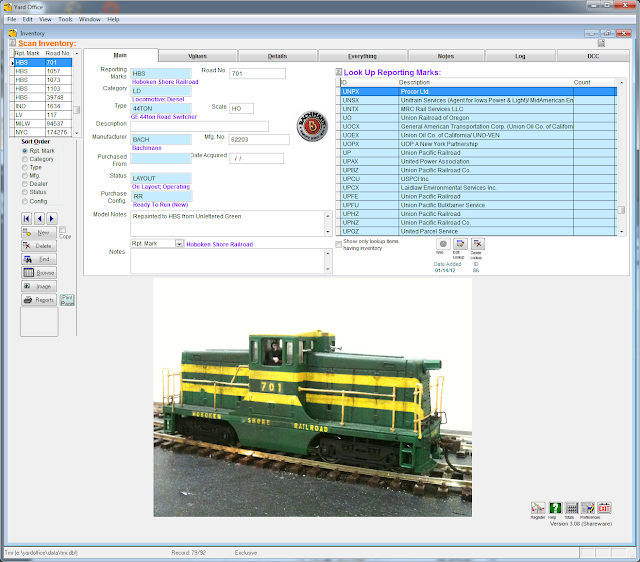
Several people have inventory applications or even simple spreadsheets that catalog and provide some measure of recording work, origin, price, etc. for locomotives and rolling stock. I use Yard Office at the moment, and it provides the feature to add a photo of your inventory item. By the way, I do like Yard Office, but I am ready for an iPhone app version that I can access while at the hobby shop, local train show, or just surfing for eBay bargains away from my computer. This would allow a quick check to see if I already had one of something (how many times do I wonder if I have that particular road number, or do I already own that unusual flatcar load?) so that my buying is as efficient as possible.

Screen shot of my Yard Office entry for a repainted Bachmann 44 tonner for the Hoboken Shore. Sharp readers will notice that the lower body section (where words "Hoboken Shore Railroad" appear) is mistakenly painted green instead of the prototypical black. This is a hazard of working with distractions around. I've already purchased another set of decals from Paul at Prime Mover Decals, but I'm not going to repaint it until I get the sound decoder working properly!

So yes, there are electronic versions of the builders photo which are very useful, but I wonder if I might prefer a printed version to have at my workbench. The back, instead of the specifications of the prototype item would have space for noting coupler type, wheelsets, trucks, accessories, light bulb, decoder, etc. while leaving room for a maintenance log with date and work performed spaces to fill in.

So why this old school physical form from such a tech guy? During the day I think a lot about the difference between virtual and actual environments and how information is handled in each. I'm very much of a computer and electronic user/proponent, but I am really concerned with appropriate use of virtual information systems, and I spend some effort to think of ways that the gap between our virtual existence and our physical being is made as small as possible. So what about the physical nature of a builder's card makes it desirable over a purely electronic record keeping method? 

The tactility of it is what appeals to me. Scratching a few notes on a piece of card stock with a no.2 pencil just seems like the right thing to do for a hobby that ultimately is all about physical objects and sensations. It may also be more "prototypical" for a 1950s railroad shop to have a file or note card system of keeping track of the essential information on capital investments, but there is just something more engaging about touching a photo card and interacting with it physically that makes the experience more than just the act of keeping a record - it is more real because it involves touching an object and not a keyboard. It may even be more convenient, since it would be in the place where maintenance happens and not at my computer desk a few steps away.

So back to my original find - the AMERICAN LOCOMOTIVE COMPANY S-2 builder's card. The best thing about it is that it is physical. And even more so than a regular photograph, the card stock it is printed on and the information on the back begs for this artifact to be held, explored, used and appreciated. Certainly different than having an image on a computer screen, and that difference is one worth thinking about. 

Huwebes, Agosto 4, 2016

Op session no 7


We had a great visiting crew last weekend for the largest operating session, yet. Nine operators put the railroad through their expert paces. Some minor hiccups, but nothing catastrophic, so I will count that as a success.

Most (all?!) played the Brakeman! game with the newly created action figures:


The Brakeman! game is about modeling the actions of the train crew. If there is an action like throwing a switch, uncoupling or coupling a car, unlocking a gate, etc., there must be one of the crew on the ground within an uncoupling tool's length in order to perform that action. In conjunction with momentum and braking in effect on the locomotive, this slows operations down a lot.

Following are some candid shots from the session:

Keith Jordan and Lance Mindheim debate the merits of something. I think we decided the world would survive.
Tom Pearson repairs several cars in place while Denny Taylor and Larry Sternberg switch the Docks Job. Jim Diaz and Kirk Baer work the Float job. 
Chuck Hitchcock and Tom Lawler figure out the HBS yard - the hardest job on the layout...?
Maneuvering the slip switch ladder in the middle of the HBS Yard. 

Kirk eyes the next move while Jim drops float cars in the float yard.
At Maxwell House Coffee Plant: "I'm pretty sure that car goes here." "Are you really sure?" "My brakeman doesn't want to walk all the way over there unless you are sure."
Denny guides Larry to the American Export docks.
"Maxwell House has too many outbound cars for this little 44-tonner." 
Paul Dolkos weighs in on the serious discussion. 

Later that same day... the yard crew at Tommy Holt's was Kirk, Keith and Paul. The GGM, AP, EXP trick in the schedule went really smoothly. No switching on Diner Siding (Tommy was looking), but eastbound trains did depart through there to keep the B Lead clear. It was a really smooth session and everyone left with all of their fingers and toes.


Lunes, Hunyo 20, 2016

That Photo of No 26 I Promised


I finally got the older photo of Erie no.26 scanned (the previous one had merger Erie-Lackawanna herald).


I like the detail of the steel tanks on the walkway. Also note the cloth flap at the front grill - I assume to keep the engine warm on bitter Northeastern nights. There also appears to be a cloth awning to provide some shade to the engineer when he hangs his head out the window. Got some detail projects now.

Linggo, Mayo 1, 2016

HBS No 500 Submitted for Printing


The SketchUp! model of the boxcab. After modeling (and correcting, and re-correcting) the file was exported to a Collada file (.DAE). I believe this option is only available in the Pro version of SketchUp! I modeled just the basic shape - I will add the details using brass, styrene, etc. after printing.


I've made the second step towards scratch building the Hoboken Shore no.500 GE/IR boxcab. I sent off the model to Shapeways for 3D printing in a flexible and strong plastic. It took a few attempts to get the model accepted because of wall thickness at a couple of spots on the model. The printer's "resolution" only allows for wall thicknesses .7mm or greater. The rounded roof was originally thinner, but hopefully the printed model won't suffer for being a few tenths of a millimeter thicker than I intended. My latest build is in for manufacturing, and I could still get errors returned from the shop when they actually try to print. If all goes well, I should receive it in a couple of weeks.

From HBS.railfan.net
I worked off of pictures from the excellent HBS.railfan.nethbs.railfan.net website, the Benjamin L. Bernhart book Hoboken Shore Railroad, and Train Shed Cyclopedia No. 43.

From Benjamin L. Bernhart's excellent reference book Hoboken Shore Railroad, 2006


For the details, I plan to model in AutoCad and print on a Makerbot Industries Thing-o-Matic 3D printer. I might need to use Shapeways again if the detail doesn't come out as well as I want with the Makerbot, as Shapeways offers finer grade plastics as well as metal laser sintering in stainless steel or alumide which may yield better results in some cases. I've seen N scale side frames 3D printed to good results, but I'll check if there are any ready-mades that are close. Railings and such will be wire, and I'm thinking the Archer rail car rivet decals for, well, the rivets.

The model after being uploaded to Shapeways.
The plan is to use Northwest Short Lines Stanton drive(s?) to power this 300 h.p. baby boxcab. Choosing a decoder will be interesting, as no one has recorded sounds from a prototype, yet. There is some discussion about which sounds that are available are closest, but it boils down to a normally aspirated 1st generation engine: a Baldwin 608 Na, although I will have some Baldwin switchers in the Erie yards already, or maybe a Galloping Goose is more in the appropriate horsepower range? :)

Any ideas are welcome, as always.

Martes, Setyembre 8, 2015

Photo of No 19 at New Harlem Freight Station


I recently found a copy of Erie Railfan (vol 1, no. 3, pp 8-9, Summer 1973) that has the second part of an excellent Larry DeYoung article on first generation diesels. Included is this photo (Ed Kelsey) of no.19 at the Harlem Station (149th Street). The building behind it is the office and freight house located on the Exterior Street side of the yard looking E-SE. No.19 was actually the fourth boxcab Erie acquired in 1928 (no.20 was the first in 1926 and nos. 21-22 in 1927).

The photo and article provide some interesting and relevant data for my layout. I now know that no.19 was at Harlem on June 12th, 1949, and that it had its end tiger striping. Cross referencing another photo from the Railroads of New York Harbor 2010 Calendar by George J. Abere, Jr. in April of 1955 shows that the striping is still there, and since it is a color photo, I know the striping is yellow as is the lettering and herald on the sides.

I also have a good reference for the building windows, awning and configuration in '49. I haven't researched this fully, yet, but the building changed over the years, so this adds a piece for nailing down what it looked like if I want to choose a specific year to model it (or perhaps multiple models for different years?)

1954

Also of note is that it looks like the ground is paved with concrete, which is previously unknown information to me. So, I go to historicaerials.com and search for "Exterior St and 149th, New York", and I find aerials from 1954 (above) showing the concrete paving. The tracks are also uncovered at this point, and I know from a 1957 photo that the two tracks, along with others) are enclosed by a building. There is also a neat feature that allows you to compare photos side by side with a slider to reveal one or the other photo. I choose 1966 and 1954 to compare (the oldest available), and notice not only the new building, but also maybe some new tracks by the centrally located crane and an elevated I-87 over Exterior St. (below)
1966

So a really good find leads me through a slew of resources to have a better idea of the evolution of the yard. I think I prefer the smaller building without the covered tracks, which means pre-'57 at some point. I may go to 1959 and simply construct the walls of the building with a removable roof for operation, or, better yet, just say it is '59 and not have the building. (Don't tell anyone if I end up doing that.)


Martes, Hunyo 30, 2015

Realignment No 1


As always planned, I am going to refine the track alignment in many sections of the layout. My overall plan was to get it down as faithfully as I could to the information I had on hand and get operating as soon as possible. This allows me to learn how the layout works, what could be brought out more in a session, see if any foci present themselves, and do more careful research on relationship of track to buildings and any prototype operational practices.
Original alignment
I have found multiple sources for track alignment of the railroad, so I can now cross-reference and verify what it was at what time. The below are for the Maxwell House/American Can complex in particular.

Left half of Maxwell House and American Can complex. (Hoboken Historical Museum)

Right half of the plant with piers into the Hudson River. (Hoboken Historical Museum)
I am nominally modeling 1959 at the moment, but that is mainly because of the Erie's situation of being at the end of it's solo career. It would be a hoot to model the HBS starting at the beginning in the 1800s, and making changes over the course of a few years evolving as the railroad did. That would be amazing, actually. Maybe I will model backwards since I have locomotive roster for that and I have to scratch build the earlier stuff. Hmmm. I like this idea. Makes scenery more of a challenge, but reworking track is easy.

Pulling up the track was easy, I use clear adhesive caulk that allows for quick removal. The only problem is if too much uplift is used, the rails will pop out of the ties, so some care is required.
Realigning was a quick exercise because of the adhesive caulk laying method: I used adhesive caulk on bare plywood. That simple. There are several areas I have eyed for realignment.

The 14th street industries might want to move back or forward so that I can model the buildings better (more on this in a later post). In particular, the US Testing building has an interesting 90 degree access track that cuts across yard tracks that make sit fun and unique. Similar for the Engine House. I would essentially need to eliminate the 14th street tracks to have enough room for this.

Also of interest is modeling the Seatrain operations that would be stunning with the crane lifts that move rail cars on and off the ship. A pier with a ship on it would be a crowd pleaser for sure. At the moment, the Seatrain tracks are about a foot long...

Rough new arrangement is not glued down, yet. I'm going to keep it unglued as I work on the American Can and Maxwell buildings so I can make adjustments. 
In the meantime, I have started on the Maxwell/American Can site with the goal to have more accuracy and more room for buildings. I've got a short film about the Maxwell House factory on order, and several great photographs. I will be scratch building/printing this large industry. I have the exact placement of the elements on a fire map, but there will need to be a little compression (of course). That is the price for being a track-centric modeler. If I were more rigorous in my prototype modeling, I would only model a portion of the railroad at true HO scale. Maybe someday I will be disciplined enough to create that type of layout.

Until then, compromises will keep the emphasis on the operations and dystopic setting on the waterfront instead of exact reproduction at scale of the physical elements. It's just one of the many challenging dichotomies model railroaders bravely face on a daily basis.

Miyerkules, Hunyo 3, 2015

Lionel ho train set no 5725


Popular Lionel ho train set no 5725

Miscellaneous antique collectible diecast cars & trucks, Home order site map diecast index search diecast. need assistance: phone 206-524-1606 during our business hours. gasoline alley antiques. Flipside records - pop records albums - flipmall.com, This is a partial list of the pop lp's we have in our store. please e-mail us if what you are looking for is not on this list. pp 21542 - bianco - sweet songs of. The cbs late movie (a titles & air dates guide), Compiled by chris tufts (a titles & air dates guide) last updated: sun, 04 nov 2012 17:00 aired from: feb 1972 to: nov 1990 cancelled/ended: 6743 airings. There are nine reasons why you must know Lionel ho train set no 5725 Find here about Lionel ho train set no 5725 and your search ends here below is information relating to Lionel ho train set no 5725 a bit review

Foto Results Lionel ho train set no 5725


Huwebes, Enero 8, 2015

Op session No 6


A quick recap of op session no.6:
Mike Barrett at 27th Street clears the car float, then fills it up again.

The Harlem Station after Barrett's completion of work before he moved over to 27th St. 
Steve Jackobs heads out of the yard to switch the HBS industries.
David Petersen (left) and Steve Jackobs (right) dropping their pickups in the HBS Yard.

Barrett, Jackobs, Petersen were on shake down duty operating the new 27th Street Lehigh station, Erie Harlem and the HBS industry jobs, but no yard this time. This was a last minute gig that conflicted with a large train show an hour away, so I didn't expect to get a lot of takers, but I needed to have trains run to find some more problems before the next session. The original idea was to have a stress test since I can now handle 11 people, which is what I was gearing up for the following weekend.

No big surprises, and mostly it confirmed work load balancing and how much time it takes to complete jobs. After this is was back to work on converting another locomotive to battery power, adding a car float and a bunch of battery charging for the next session...

Linggo, Marso 16, 2014

Op Session No 3


Op session No.3 on the PoNY is in the books. Tom Pearson drove down from Fort Worth, and George Zapalac and Steve Jackobs (part of the South Austin cartel) attended. George and Steve handled the line jobs out in the Docks, the Float Yard, Bethlehem Steel Shipyard and Maxwell House. The session started with a brief introduction for the rookies.

In my briefing, I try to do three things: set the mies en scene using maps, images and descriptions of intent, provide practical information about taking care of crew necessities (where's the restroom, drinks and chairs), and set operating expectations. I explain my 'thesis' for the layout, which is the central organizing element for everything on the layout.

I want the operators to get a feel for the everydayness of this particular place. It is not about solving puzzles (although there are plenty of switching puzzles throughout), it is not about stress from timetables (we essentially have a 1:1 clock), external expectations or conflicting movement, it is not about finishing first. In fact, I state tongue in cheek that the first person to finish their assignments 'loses'. In other words, slow down and become intimate with what is happening on the layout, your locomotive, and your fellow operators.


It is a game, but we are not moving abstract pieces around a two-dimensional game board, we are re-enacting / recreating the people who actually lived and worked here and their activities that actually happened in order to understand them both better. The culmination of these three goals of the briefing is to offer several ways of playing the game to best fit the skill level and interests of the participants.


Each locomotive is set up to have momentum and braking, and we use switch lists (no car cards anywhere), which becomes a baseline of playing. Beyond that, the individual can choose how prototypically they play they wish to play the game. The next level up from the base line is to use horn and bell properly. Then employing brakemen like wargaming miniatures to further immerse the operator into the people and pace of the place we are simulating. There are certain rules being developed for this part.

To start with, all switch and coupler actions must occur with a brakeman on the ground at that location. A brakeman may ride on cars or locomotive, and they can perform tasks within the radius of a long bamboo skewer uncoupling tool. They may also walk, but their movement is decidedly slow, and they get grumpy if continually asked to do this. I leave it up to the individual and their conscience on how to treat their crew. At this time, we use yellow wire nuts, but later these will be scale figures with accommodating bases and handles to be able to move them around easily.


The next level up on the operating realism scale includes pauses for brake hose connections, interactions with customers, etc. At this point, ,whatever the crew decides, but later a more detailed and explained menu of items will be provided. Another layer will be layout-provided as I get around to implementing ideas. These will include gate locks, perhaps customer interactions, loading and unloading timing, the car float movement, weighing cars at the scale, refueling locomotives, etc.

Employing an entire prix fix menu of all of these items would increase 'play density' by at least double in my projection. At this point it becomes clear that there are more things modeled about the railway operations beyond moving the cars than the actual movement of the cars themselves. Again, the point of all of this is to feel what it was like to be a railroader at this particular place - not just to complete a puzzle as fast as possible. And time plus the 'play density' equation should yield much more satisfaction of quality of experience over a quantified satisfaction of moving "x" number of cars and finishing fast. I understand that this is tantamount to a treasonous, un-American way of thinking these days, but it is all about 'how' the railway is operated, not about the amount of cars moved.

The line jobs took about 45 minutes each making 5-6 drops and 5-6 car pick ups. That's spending about 4.5 minutes moving each car and moving 20 cars a session. The reason for the extended play time with so few car movements is the braking and momentum settings on the locomotives at this point, but will be considerable extended when more menu items are added. If memory serves, Tommy Holt and David Barrow have talked about an operator moving 4 times as many cars in one of their sessions. I'll need to double check this figure. David is slowly introducing momentum and braking to his locomotives with varying degrees of acceptance by crew, but the effect will be to lengthen an operating session while moving the same amount of traffic.

In the yard, Tom serviced the 14th Street industries first, then fiddled the Erie and interchange yards. He employed the line engineers on occasion in the yard to help make moves before sending them back out on their way. On the HBS, I am encouraging this amongst the assigned jobs, so it is not about the jobs, but it is about the cooperation and the teamwork involved in keeping a busy short line moving their customers' goods quickly and efficiently. This approach is informed by how the railroad actually operated as told by employees.

From interviews by others, I have learned that there were some pretty interesting moves made in the yards with two switchers working together. Known as Broadway Yard (the HBS tracks) and Delaware Yard (the Erie tracks), the interchange between the two railroads involved some interesting moves made possible by the interstitial double slip spring switch ladder found in the HBS yard. There are also descriptions of pole switching in tight quarters on some short run around sections. I have yet to dig into it to figure out where this occurred. I wonder how one would model pole switching. Surely someone has done this already. Let me know who!

In the de-briefing session, I asked for anything that annoyed or disrupted the quality of the experience. Aside from a shockingly small number of technical issues, there were no complaints. It was noted that the slower pace was decidedly different than other local operating session styles, and that this was welcomed. The locomotives performed amazingly well, and at one point Steve asked how I kept my track so clean since he had experienced no stalls. He actually caught himself before saying this out loud realizing that the locomotives were battery powered, but he asked it anyway for a good laugh line.

The trailing battery car did not bother anyone, and all agreed that when they become enclosed and prototypical cars, it won't be any issue at all. Even now, everyone says they stop seeing the exposed wires and battery in very short order.

I deem this session a success. Lots more on the horizon, but I am totally comfortable and
satisfied at this point. I'll discuss more about the actual jobs and train movements in a future post.