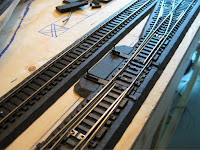
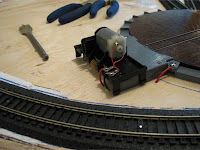
From a response I gave to a fellow industrial switching devotee's email question about how I handle generating switch lists on the PoNY. I thought some others may be interested as well:
For my switch lists, I simply walk around and make them up prior to a session. My railroad is small enough that there is no need to involve a computer or car cards. My mantra is "simplicity". I am a designer/architect and was by profession/am at heart an academic, and one of my favorites in that world is John Maeda who used to head MIT's design research lab and wrote about the Laws of Simplicity.
For my layout, I try to make everything as simple as possible. Battery power means no wiring, no track cleaning, no shorting, no etc. The prototype I chose means no signalling, CTC panels, telephones or radios, etc. Then, I am trying to be really rigorous by choosing no car cards and only using switch lists, not having a double deck, no hidden staging, no dcc, no plug in throttles, etc.
So for filling out the switch lists, I know which spots take what kind of car and how many. I have an idea of the traffic flow I want to create. My operator jobs are compartmentalized, and I don't use car cards, so the process takes only as long as it takes me to write the lists. Now the yard is something I have not quite worked out, yet.
I don't want car cards, and unfortunately, those are very helpful in a yard as they are physical, self-correcting, and have a one-to-one relationship with the actual car, etc. I am trying to use wheel report sheets kept in real time by the Yardmaster who then makes up switch lists from there. I have the "staging" area, which is just Erie yard tracks that connect to the HBS, on one sheet by track with all the cars listed. Then as they are brought into the interchange yard, they are written on the sheet according to what track they get put on. Ideally, the cut of cars should come with its own switch list from the Erie operator. I'm still working this procedure out.
Wheel report sheet for the HBS (above).
Interchange wheel report sheet (above). The Erie tracks at the bottom are "staging" and the 4 tracks shown are the interchange yard. The idea is that the Erie operator and the HBS YM will jointly use this sheet to move cars back and forth between railroads.
Once in a track in the interchange yard, the YM can make up a drill order for his yard crews to sort the cars. Then they get put on a classification track for later, or in a track being made up for one of the local jobs. Once that is accomplished, the yard wheel report sheet is updated, and a switch list for the train is made up that the conductor will take with him on the job. When the car reaches ts destination, it sits until it happens to move according to my balancing the work of each operator job.
As mentioned, jobs are compartmentalized, so traffic flow is first and foremost about a single operator's work. The consequences are felt in the yard, of course, but in a session, not too much can really go wrong, because there is enough room in the yard for the traffic, and we operate so slowly, that we have yet to really test the flow of cars on and off the railroad to the Erie. Crews are having enough to handle with the industry switching. I expect this to change as operators get more experience, but because operations are so slow, I doubt there will be problems.
I am having a session in September with lots of experienced operators visiting from all over, so that will be a good test. It will also be the most operators here at once - 11. So far I have only hosted 8 maximum. I do have another pocket terminal completed (pictures coming) that adds two operators without affecting the rest of the layout, so I am not anticipating any particular new problems...